The Prague Post - Chewed for millennia, coca leaf gets flavorsome makeover in Bolivia

EUR -
AED 4.294825
AFN 74.26706
ALL 95.235068
AMD 433.678625
ANG 2.09282
AOA 1073.370481
ARS 1639.321515
AUD 1.630671
AWG 2.10757
AZN 1.983767
BAM 1.954352
BBD 2.355281
BDT 143.513037
BGN 1.950426
BHD 0.441275
BIF 3478.514393
BMD 1.169249
BND 1.491795
BOB 8.110989
BRL 5.829169
BSD 1.169398
BTN 111.160625
BWP 15.874236
BYN 3.307749
BYR 22917.271297
BZD 2.352357
CAD 1.59109
CDF 2707.979679
CHF 0.9161
CLF 0.027111
CLP 1067.058417
CNY 7.98626
CNH 7.987499
COP 4355.789877
CRC 531.703711
CUC 1.169249
CUP 30.985086
CVE 110.669075
CZK 24.389764
DJF 207.79897
DKK 7.471206
DOP 69.684246
DZD 154.709155
EGP 62.596073
ERN 17.538728
ETB 183.572115
FJD 2.570418
FKP 0.860826
GBP 0.863975
GEL 3.13369
GGP 0.860826
GHS 13.089782
GIP 0.860826
GMD 85.893092
GNF 10263.082116
GTQ 8.937581
GYD 244.66869
HKD 9.159717
HNL 31.125034
HRK 7.533704
HTG 153.045827
HUF 364.875679
IDR 20356.383154
ILS 3.442262
IMP 0.860826
INR 111.417985
IQD 1531.715582
IRR 1537561.824436
ISK 143.384723
JEP 0.860826
JMD 184.233475
JOD 0.828938
JPY 183.840366
KES 151.043924
KGS 102.216292
KHR 4691.024848
KMF 491.706982
KPW 1052.32368
KRW 1726.734529
KWD 0.360158
KYD 0.974678
KZT 542.507978
LAK 25700.082866
LBP 104706.206972
LKR 373.699876
LRD 214.995535
LSL 19.479861
LTL 3.452487
LVL 0.707266
LYD 7.424954
MAD 10.817011
MDL 20.135079
MGA 4852.381592
MKD 61.647295
MMK 2455.12932
MNT 4182.022623
MOP 9.436707
MRU 46.735016
MUR 54.674246
MVR 18.070718
MWK 2036.248415
MXN 20.483305
MYR 4.622065
MZN 74.727051
NAD 19.479797
NGN 1608.090757
NIO 42.92346
NOK 10.840922
NPR 177.85492
NZD 1.990535
OMR 0.449576
PAB 1.169633
PEN 4.101138
PGK 5.073077
PHP 72.140349
PKR 325.957278
PLN 4.257696
PYG 7270.612157
QAR 4.260154
RON 5.194741
RSD 117.373328
RUB 88.256626
RWF 1708.856735
SAR 4.387249
SBD 9.403225
SCR 16.261884
SDG 702.132427
SEK 10.85612
SGD 1.493049
SHP 0.872962
SLE 28.761299
SLL 24518.552683
SOS 667.640738
SRD 43.795355
STD 24201.083982
STN 24.799761
SVC 10.234372
SYP 129.231176
SZL 19.479343
THB 38.292859
TJS 10.947887
TMT 4.098216
TND 3.403178
TOP 2.81527
TRY 52.847116
TTD 7.944113
TWD 37.041623
TZS 3034.19965
UAH 51.53521
UGX 4388.865567
USD 1.169249
UYU 47.105093
UZS 13972.520287
VES 571.6956
VND 30797.421802
VUV 138.881917
WST 3.17473
XAF 655.471267
XAG 0.016066
XAU 0.000259
XCD 3.159953
XCG 2.108038
XDR 0.813364
XOF 654.779359
XPF 119.331742
YER 278.980485
ZAR 19.663779
ZMK 10524.646391
ZMW 21.90177
ZWL 376.497551
  • CMSC

    -0.0100

    22.87

    -0.04%

  • BCC

    -3.8000

    74.33

    -5.11%

  • RYCEF

    -0.3000

    16

    -1.88%

  • NGG

    -0.9800

    87.5

    -1.12%

  • CMSD

    -0.0300

    23.25

    -0.13%

  • RIO

    -1.9500

    98.63

    -1.98%

  • BTI

    -0.3600

    58.35

    -0.62%

  • RBGPF

    0.5000

    63.1

    +0.79%

  • JRI

    -0.0500

    12.93

    -0.39%

  • GSK

    -0.7100

    50.9

    -1.39%

  • BP

    0.5300

    46.94

    +1.13%

  • VOD

    -0.1000

    16.05

    -0.62%

  • RELX

    0.0100

    36.36

    +0.03%

  • AZN

    -1.2800

    183.46

    -0.7%

  • BCE

    -0.0300

    23.93

    -0.13%

Chewed for millennia, coca leaf gets flavorsome makeover in Bolivia
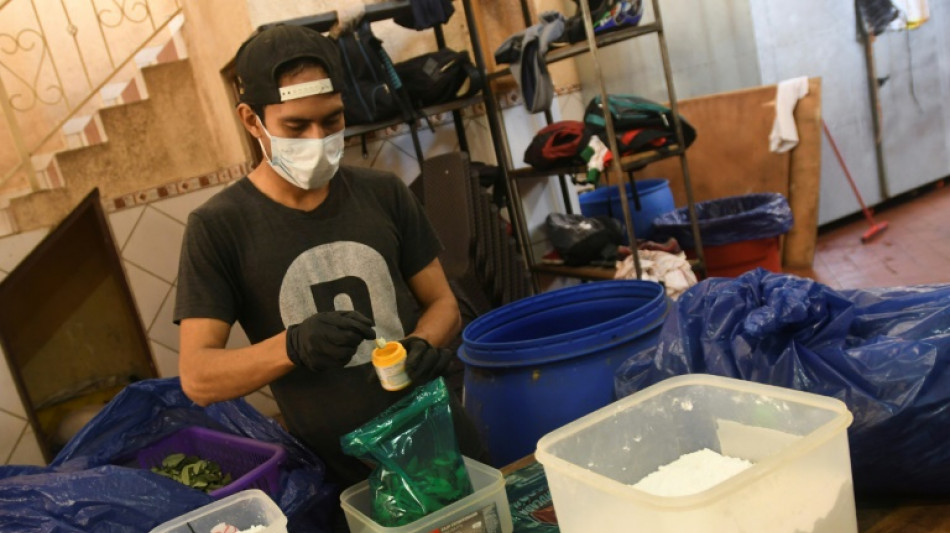
Chewed for millennia, coca leaf gets flavorsome makeover in Bolivia / Photo: RODRIGO URZAGASTI - AFP

Chewed for millennia, coca leaf gets flavorsome makeover in Bolivia

Bitter and tough, the coca leaf chewed throughout the South American Andes for thousands of years as a natural pick-me-up has been getting an appetizing makeover in Bolivia.

Text size:

Traditionally sold as untreated, chopped leaves, several small businesses are now bruising the foliage to make it softer, and adding flavors such as strawberry, mango or coffee.

What started as an experiment about a decade ago has really taken off, especially in Bolivia's economic capital of Santa Cruz -- a city of 3.4 million people.

"The flavoring is like adding seasoning to food. Normally flavors such as bubblegum, banana are used, and it adds a special something," consumer Isaac Salazar, 21, told AFP.

"They come already crushed, soft, with a savory or sweet flavor added, which makes it perfect for passing the time."

The practice of chewing coca has its own verb in Bolivia's Indigenous Aymara language: "pijcheo." It means to masticate the leaves, like chewing gum, without swallowing.

The leaf -- from the same plant that cocaine is manufactured from -- has been ascribed with the wide-ranging properties of quelling hunger, inhibiting stress and imparting an energy boost.

Coca is also consumed in infusions, and in some countries it is included in flour used to make special breads and cakes.

- Bruised coca -

The work of transforming the fibrous leaf into a more easily chewable product is laborious.

At the El Dogor factory and store run by 23-year-old Luis Vasquez in Santa Cruz, about 20 workers share the tasks of removing the hard stems, placing what is left of the foliage into plastic bags, adding flavorings, and pounding away with a mallet.

The flattened end product, labeled Machucada (bruised) Coca El Dogor is placed in the fridge, and sold for $4.30 per unit of four ounces (about 113 grams).

The shop does a brisk business.

"We have a variety of coca leaf products, including fruit-flavored leaves and any other flavor a customer may ask for," said Vasquez.

More and more, clients "prefer it mixed with a flavoring," he said.

Consumer Gary Soleto, 45, said the traditional way of consuming unadulterated coca leaf will never disappear.

"But we change and we have taken on new habits... to continue consuming and tasting new flavors," he said.

Official data show that one in three people in a country of 12 million -- almost a third of them Indigenous -- chew coca or use it for medicinal and ritual purposes.

In 2021, there were 30,500 hectares (75,000 acres) of coca plantations in Bolivia, according to a UN estimate -- up four percent from 2020.

Potential coca leaf production was estimated at 44,900 to 56,200 metric tons with an estimated value of $352 million to $431 million, according to a report by the UN Office on Drugs and Crime.

The Bolivian state authorizes the cultivation of a maximum of 22,000 hectares.

In recent years, there have been clashes between coca leaf producers and police in Bolivia in a dispute over control of commercialization of the plant.

P.Benes--TPP