Javan rhino clings to survival after Indonesia poaching wave / Photo: Handout - ENVIRONMENT AND FORESTRY MINISTRY/AFP
In 2023, a newborn Javan rhino in Indonesia raised hopes for the highly endangered species. Now, conservationists fear poachers have killed up to a third of the surviving population, possibly with inside help.
Since last year, authorities have arrested six alleged poachers. But eight remain on the run, including one who managed to flee his home hours before police arrived.
The fugitive reportedly had recent data on rhinos in Java's Ujung Kulon national park, the only place in the world the species is still found, sparking fears he had inside assistance.
The poachers claim two gangs have killed 26 rhinos since 2018 -- between a third and a quarter of the species' estimated population.
"It's a huge number," said Nina Fascione, director of the International Rhino Foundation, adding that she was "shocked and devastated".
The suspects reportedly said they killed the rhinos for their horns, which command huge sums from black market buyers in China.
Though horns are made of keratin -- the same substance found in hair and nails -- they are prized for medicinal purposes.
Indonesian police have arrested a collector who bought rhino horns from the gang for 500 million rupiah ($30,500).
While rhino poaching for horns is common elsewhere, the Indonesian case has taken some conservationists by surprise.
"The poaching of the Javan rhino is really a new topic," said Timer Manurung, director of local environmental NGO Auriga Nusantara, which tracks the species.
Poaching of the animal had rarely been reported in recent decades on Java, Indonesia's most populated island.
But last year, Auriga Nusantara reported worrying signs that poachers were encroaching into Ujung Kulon: snares had been discovered and a dead rhino was found with a hole in its head.
- Insider help? -
Still, the scale of the problem exceeds the worst fears of conservationists, and has raised questions about how the poachers tracked the protected animals.
"There were several indications of insider help," including the apparent tip-off of the fugitive poacher and claims he had recent data on rhino locations, said Timer.
Muhammad Ali Imron, head of WWF Indonesia's forest and wildlife programme, told AFP there should be a "full assessment" of all involved in the rhino's conservation over potential collusion.
Indonesian law enforcement has not yet confirmed any insider help, but Fascione said poachers elsewhere have often operated with assistance from those meant to protect the species.
"All it takes is somebody with financial problems... who needs money quickly, urgently, and they're susceptible," said Fascione.
"This is a problem everywhere."
Local reports of the poaching claims began to emerge in April, but it was not until early June that police and the park head paraded suspects before media and released details of their alleged crimes.
And the poachers' claims "need further verification by checking the remains of bones and other signs on the ground," Satyawan Pudyatmoko, Indonesia's directorate general of Nature Resources and Ecosystem Conservation, told AFP.
He said officials had "not seen any such indication" of inside help, and said suspects were tipped off by residents of a nearby village.
Earlier this month, one of the arrested poachers was handed a 12-year prison sentence, the most severe ever given for an Indonesian wildlife crime, after a trial that lasted weeks.
The national park has also beefed up security with round-the-clock patrols, and experts say rangers are working hard to improve protection.
- Numbers 'doubtful' -
Now the question is just how many Javan rhinos remain.
Even before the poaching was revealed, doubts had been cast on the government's estimate of the wild population.
Satyawan told AFP there were an estimated 76 in 2021 and 80 in 2022, based on track monitoring and camera traps.
They now believe 82 remain despite the poaching, with new births expanding the population.
But Auriga said last year that only 63 had been confirmed by sightings in 2018.
That could mean the true figure for Javan rhinos in the wild is now closer to just 50.
An immediate, "transparent and credible" assessment of the species is now needed, said Timer.
"The current number of the population really needs to be reassessed."
He called for respected experts to be given full access to park data to do the count of the rhinos, which can live between 30 and 45 years.
"Without those, the number will be doubtful," he added.
The species has been threatened for decades. It disappeared from its last refuge outside Indonesia, in Vietnam, in 2010, due to poaching.
But conservationists say they are not giving up hope yet for the species in Indonesia, where the population has previously rebounded after nearly dying out.
"The Indonesian government has brought Javan rhinos back from the brink of extinction previously, and can do so again," said Fascione.
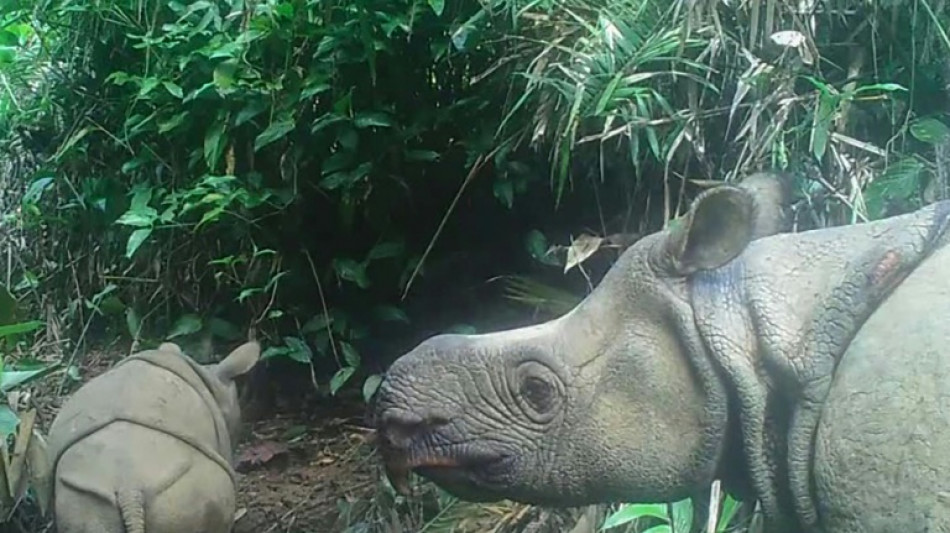
In March, another Javan rhino calf, estimated to be three months old, was spotted on camera at Ujung Kulon, showing the species is still breeding properly.
"Javan rhinos know what to do," Fascione said.
"They just need to be protected to do it."
F.Prochazka--TPP