The Prague Post - Scientists successfully grow plants in soil from the Moon

EUR -
AED 4.304793
AFN 75.018807
ALL 95.472997
AMD 434.616987
ANG 2.098046
AOA 1076.050478
ARS 1632.265422
AUD 1.628611
AWG 2.109903
AZN 1.989654
BAM 1.957166
BBD 2.36138
BDT 143.854547
BGN 1.955296
BHD 0.44267
BIF 3488.373035
BMD 1.172168
BND 1.495565
BOB 8.101243
BRL 5.827085
BSD 1.172434
BTN 111.217456
BWP 15.933279
BYN 3.308478
BYR 22974.499827
BZD 2.357968
CAD 1.594033
CDF 2719.430131
CHF 0.917081
CLF 0.026797
CLP 1054.658072
CNY 8.003859
CNH 7.995624
COP 4286.912729
CRC 533.026705
CUC 1.172168
CUP 31.062462
CVE 110.711345
CZK 24.379989
DJF 208.317171
DKK 7.472643
DOP 69.748105
DZD 155.099004
EGP 62.634792
ERN 17.582525
ETB 184.030546
FJD 2.570624
FKP 0.863441
GBP 0.86414
GEL 3.141364
GGP 0.863441
GHS 13.132293
GIP 0.863441
GMD 85.56768
GNF 10285.777375
GTQ 8.957132
GYD 245.27903
HKD 9.182474
HNL 31.202937
HRK 7.535405
HTG 153.582948
HUF 363.073257
IDR 20379.319081
ILS 3.459479
IMP 0.863441
INR 111.329738
IQD 1535.54055
IRR 1540229.223365
ISK 143.801703
JEP 0.863441
JMD 183.708257
JOD 0.831038
JPY 183.968891
KES 151.439949
KGS 102.471545
KHR 4703.327197
KMF 492.310913
KPW 1054.951494
KRW 1722.472039
KWD 0.361075
KYD 0.977053
KZT 543.05168
LAK 25764.260233
LBP 104967.676802
LKR 374.708368
LRD 215.532467
LSL 19.528583
LTL 3.461108
LVL 0.709033
LYD 7.443066
MAD 10.844023
MDL 20.200568
MGA 4864.499069
MKD 61.645695
MMK 2460.9559
MNT 4193.843189
MOP 9.460391
MRU 46.851964
MUR 54.810523
MVR 18.11585
MWK 2041.331642
MXN 20.472976
MYR 4.633535
MZN 74.895763
NAD 19.528485
NGN 1611.110648
NIO 43.030716
NOK 10.857362
NPR 177.939374
NZD 1.985729
OMR 0.450692
PAB 1.172404
PEN 4.11138
PGK 5.085746
PHP 72.253624
PKR 326.771221
PLN 4.253594
PYG 7210.741673
QAR 4.270792
RON 5.198806
RSD 117.417331
RUB 87.914502
RWF 1713.124056
SAR 4.395608
SBD 9.426707
SCR 16.243007
SDG 703.88472
SEK 10.830606
SGD 1.493759
SHP 0.875142
SLE 28.835408
SLL 24579.7799
SOS 669.30821
SRD 43.907102
STD 24261.518423
STN 24.861691
SVC 10.259169
SYP 129.553886
SZL 19.528294
THB 38.116579
TJS 10.997075
TMT 4.10845
TND 3.377896
TOP 2.8223
TRY 52.981658
TTD 7.958303
TWD 37.048703
TZS 3059.359673
UAH 51.51602
UGX 4408.51035
USD 1.172168
UYU 46.757231
UZS 14007.411865
VES 573.123227
VND 30873.156311
VUV 137.907235
WST 3.182659
XAF 656.462918
XAG 0.015743
XAU 0.000256
XCD 3.167843
XCG 2.11301
XDR 0.815395
XOF 656.414482
XPF 119.331742
YER 279.67633
ZAR 19.48935
ZMK 10550.925377
ZMW 21.894874
ZWL 377.437733
  • RBGPF

    0.5000

    63.1

    +0.79%

  • CMSC

    0.0600

    22.88

    +0.26%

  • RIO

    0.1000

    100.58

    +0.1%

  • GSK

    -0.7000

    51.61

    -1.36%

  • AZN

    -2.6300

    184.74

    -1.42%

  • RELX

    -0.2400

    36.35

    -0.66%

  • BCE

    0.1800

    23.96

    +0.75%

  • BTI

    -0.0900

    58.71

    -0.15%

  • CMSD

    0.1500

    23.28

    +0.64%

  • BCC

    -1.1400

    78.13

    -1.46%

  • JRI

    -0.0100

    12.98

    -0.08%

  • NGG

    -1.0600

    88.48

    -1.2%

  • BP

    -0.9700

    46.41

    -2.09%

  • VOD

    0.3500

    16.15

    +2.17%

  • RYCEF

    0.5500

    16.35

    +3.36%

Scientists successfully grow plants in soil from the Moon
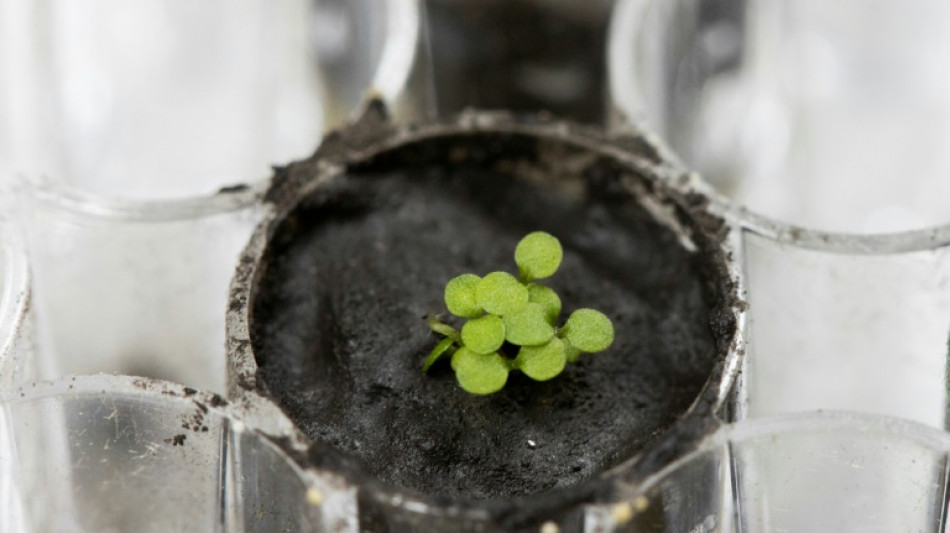
Scientists successfully grow plants in soil from the Moon / Photo: Tyler JONES - UF/IFAS Communications/AFP

Scientists successfully grow plants in soil from the Moon

That's one small pot of soil, one giant leap for man's knowledge of space agriculture: scientists have for the first time grown plants in lunar soil brought back by astronauts in the Apollo program.

Text size:

The ground-breaking experiment, detailed in the journal Communications Biology on Thursday, has given researchers hope that it may be possible to one day grow plants directly on the Moon.

That would save future space missions much hassle and expense, facilitating longer and farther trips.

However, according to the study's University of Florida authors, much remains to be studied on the topic, and they intend to leave no stone unturned.

"This research is critical to NASA's long-term human exploration goals," said Bill Nelson, the head of the US space agency. "We'll need to use resources found on the Moon and Mars to develop food sources for future astronauts living and operating in deep space."

For their experiment, the researchers used just 12 grams (a few teaspoons) of lunar soil collected from various spots on the Moon during the Apollo 11, 12, and 17 missions.

In tiny thimble-sized pots, they placed about a gram of soil (called "regolith") and added water, then the seeds. They also fed the plants a nutrient solution every day.

The researchers chose to plant arabidopsis thaliana, a relative of mustard greens, because it grows easily and, most importantly, has been studied extensively. Its genetic code and responses to hostile environments -- even in space -- are well known.

As a control group, seeds were also planted in soil from Earth as well as samples imitating lunar and Martian soil.

The result: after two days, everything sprouted, including the lunar samples.

"Every plant -- whether in a lunar sample or in a control -- looked the same up until about day six," Anna-Lisa Paul, lead author of the paper, said in a statement.

But after that, differences started to appear: the plants in the lunar samples grew more slowly and had stunted roots.

After 20 days, the scientists harvested all the plants, and ran studies on their DNA.

Their analysis showed that the lunar plants had reacted similarly to those grown in hostile environments, such as soil with too much salt, or heavy metals.

In the future, scientists want to understand how this environment could be made more hospitable.

NASA is preparing to return to the Moon as part of the Artemis program, with a long-term goal of establishing a lasting human presence on its surface.

P.Benes--TPP