The Prague Post - 'Come and kill me': sick ants invite destruction to save colony

EUR -
AED 4.317808
AFN 76.994475
ALL 96.189964
AMD 448.7811
ANG 2.104722
AOA 1077.985852
ARS 1704.836554
AUD 1.773409
AWG 2.116003
AZN 2.007197
BAM 1.9543
BBD 2.367312
BDT 143.640939
BGN 1.953544
BHD 0.443191
BIF 3485.527834
BMD 1.175557
BND 1.515391
BOB 8.121523
BRL 6.421132
BSD 1.175363
BTN 106.812813
BWP 15.523619
BYN 3.444453
BYR 23040.925982
BZD 2.363915
CAD 1.616703
CDF 2645.004589
CHF 0.934556
CLF 0.027368
CLP 1073.648601
CNY 8.284448
CNH 8.269941
COP 4520.018388
CRC 586.532218
CUC 1.175557
CUP 31.152272
CVE 110.721405
CZK 24.324665
DJF 208.920182
DKK 7.471185
DOP 74.470932
DZD 152.190865
EGP 55.705908
ERN 17.633362
ETB 182.27006
FJD 2.684964
FKP 0.878605
GBP 0.876131
GEL 3.168094
GGP 0.878605
GHS 13.548259
GIP 0.878605
GMD 86.404864
GNF 10216.182599
GTQ 9.000783
GYD 245.903882
HKD 9.145496
HNL 30.811895
HRK 7.529561
HTG 153.931817
HUF 385.673373
IDR 19576.558183
ILS 3.794346
IMP 0.878605
INR 106.897786
IQD 1539.980257
IRR 49502.723816
ISK 147.990962
JEP 0.878605
JMD 188.656761
JOD 0.83352
JPY 181.871704
KES 151.541393
KGS 102.802907
KHR 4706.932036
KMF 493.73405
KPW 1058.001998
KRW 1732.783652
KWD 0.360285
KYD 0.979519
KZT 605.856806
LAK 25468.45215
LBP 105271.169589
LKR 363.860641
LRD 208.367869
LSL 19.761085
LTL 3.471115
LVL 0.711083
LYD 6.371567
MAD 10.794561
MDL 19.793214
MGA 5301.763793
MKD 61.443207
MMK 2468.395605
MNT 4169.516512
MOP 9.418189
MRU 46.728714
MUR 54.016691
MVR 18.102491
MWK 2041.943832
MXN 21.114822
MYR 4.802741
MZN 75.12987
NAD 19.760977
NGN 1708.425936
NIO 43.175966
NOK 11.970655
NPR 170.9007
NZD 2.032451
OMR 0.451998
PAB 1.175363
PEN 3.963393
PGK 4.99994
PHP 68.878852
PKR 329.449854
PLN 4.213221
PYG 7894.938542
QAR 4.28021
RON 5.09216
RSD 117.362953
RUB 93.516769
RWF 1706.909415
SAR 4.409202
SBD 9.592601
SCR 16.789394
SDG 707.092237
SEK 10.92522
SGD 1.51537
SHP 0.881973
SLE 28.155038
SLL 24650.856215
SOS 671.827144
SRD 45.468202
STD 24331.665734
STN 24.921818
SVC 10.285191
SYP 12999.86794
SZL 19.761454
THB 36.971654
TJS 10.801685
TMT 4.114451
TND 3.42263
TOP 2.830461
TRY 50.209937
TTD 7.973641
TWD 36.98652
TZS 2903.626567
UAH 49.570363
UGX 4184.787067
USD 1.175557
UYU 45.984695
UZS 14253.633675
VES 314.39079
VND 30970.06097
VUV 142.785345
WST 3.267242
XAF 655.434266
XAG 0.01851
XAU 0.000273
XCD 3.177003
XCG 2.118311
XDR 0.816048
XOF 656.55533
XPF 119.331742
YER 280.312047
ZAR 19.695537
ZMK 10581.505648
ZMW 27.004463
ZWL 378.529019
  • RBGPF

    3.3200

    81

    +4.1%

  • CMSC

    -0.0140

    23.286

    -0.06%

  • RYCEF

    -0.1000

    14.8

    -0.68%

  • GSK

    -0.4700

    48.77

    -0.96%

  • RIO

    0.3850

    76.205

    +0.51%

  • BTI

    -0.3450

    57.395

    -0.6%

  • NGG

    -0.3300

    75.7

    -0.44%

  • SCS

    0.0200

    16.14

    +0.12%

  • VOD

    0.0050

    12.705

    +0.04%

  • RELX

    -0.2500

    40.83

    -0.61%

  • BP

    -1.4650

    33.785

    -4.34%

  • CMSD

    -0.0200

    23.345

    -0.09%

  • AZN

    -0.5000

    91.06

    -0.55%

  • BCC

    0.6750

    76.005

    +0.89%

  • JRI

    -0.0600

    13.5

    -0.44%

  • BCE

    -0.1450

    23.465

    -0.62%

'Come and kill me': sick ants invite destruction to save colony
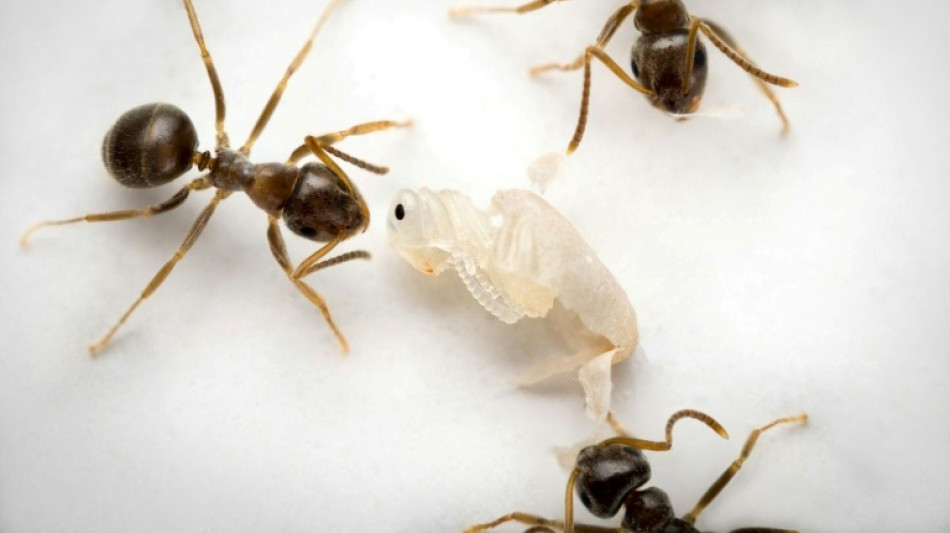
'Come and kill me': sick ants invite destruction to save colony / Photo: Christopher PULL - ISTA/AFP

'Come and kill me': sick ants invite destruction to save colony

Sick young ants release a smell to tell worker ants to destroy them to protect the colony from infection, scientists said Tuesday, adding that queens do not seem to commit this act of self-sacrifice.

Text size:

Many animals conceal illness for social reasons. For example, sick humans are known to risk infecting others so they can still go to the office -- or the pub.

Ant colonies, however, act as one "super-organism" which works to ensure the survival of all, similar to how infected cells in our bodies send out a "find-me and eat-me" signal, according to an Austria-led team of scientists.

Ant nests are a "perfect place for a disease outbreak to occur because there are thousands of ants crawling over each other," Erika Dawson, a behavioural ecologist at the Institute of Science and Technology Austria and lead author of a new study, told AFP.

When adult worker ants get an illness that could spread through the colony, they leave the nest to die alone.

Young ants, known as pupae, in contrast are still trapped inside a cocoon, making this kind of social distancing impossible.

Scientists had already figured out that when these pupae are terminally ill, there is a chemical change that produces a particular smell.

Adult worker ants then gather around, remove the cocoon, "bite holes in the pupae and insert poison," Dawson said.

The poison acts as a disinfectant, which kills both the colony-threatening pathogen and the pupae.

For the new research, the scientists wanted to figure out whether the pupae "were actively saying: 'hey, come and kill me'," Dawson said.

- 'Altruistic act' -

First, the scientists extracted the smell from the sick pupae of a small black garden ant called Lasius neglectus. When they applied the smell to a healthy brood in the lab, the workers still destroyed them.

Then, the team conducted an experiment showing that the sick pupae only produce the smell when worker ants are nearby, proving it is a deliberate signal for destruction.

"While it is a sacrifice -- an altruistic act -- it's also in their own interest, because it means that their genes are going to survive and be passed on to the next generation," Dawson said.

However, there is one member of the nest that does not sacrifice itself.

When queen pupae are infected inside their cocoons, they do not send out the smelly warning signal, the team found.

"Are they cheating the system?" Dawson said the team asked themselves.

However, they found that the "queen pupae have much better immune systems than the worker pupae, and so they were able to fight off the infection -- and that's why we think that they weren't signalling", she said.

Dawson hopes future research will investigate whether queen pupae sacrifice themselves when it becomes clear they will not beat their infection.

The study was published in the journal Nature Communications.

F.Prochazka--TPP