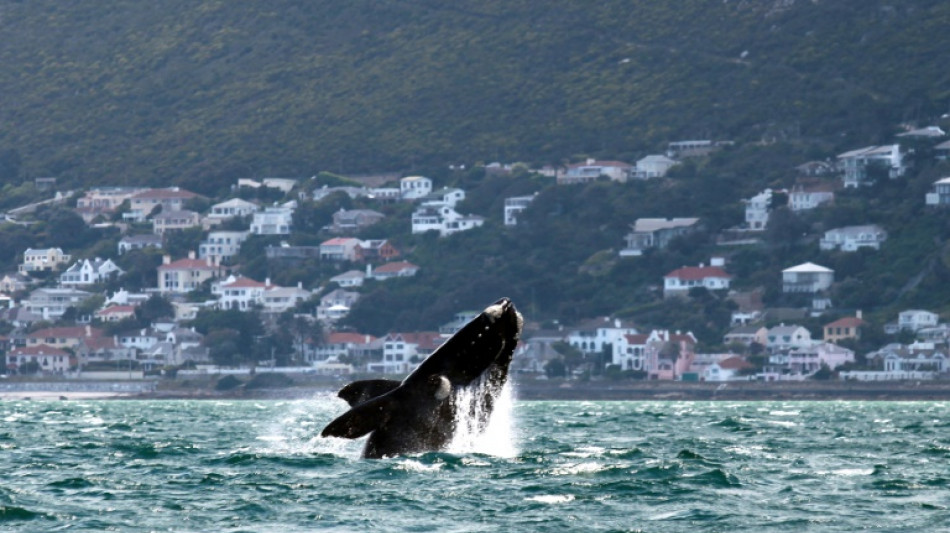
Middle East conflicts a danger for whales off S.Africa: study / Photo: JENNIFER BRUCE - AFP/File
Conflicts in the Middle East are increasing dangers for whales off South Africa by shifting sea traffic into their habitats and heightening the risks of collision, researchers told AFP.
The rerouting of shipping around South Africa and away from the Red Sea and Suez Canal since late 2023 has "substantially increased" the chances of ship strikes, they said in new research.
South Africa's southwestern coast supports globally significant populations of whales as well as increasingly busy shipping corridors, according to a paper presented to an International Whaling Commission (IWC) meeting this month.
This "extensive spatial overlap" amplifies the chances of collisions, said the paper, presented by University of Pretoria whale unit lead researcher Els Vermeulen.
Some global sea traffic was diverted from the Red Sea route following the November 2023 hijacking by Houthi rebels of a British-owned vehicle carrier, the Galaxy Leader, near Yemen.
Subsequent attacks and the US-Israel conflict with Iran, which has blocked transit through the Strait of Hormuz, have led shipping companies to reroute more of their vessels around the Cape of Good Hope.
Between March 1 and April 24 this year, an average of 89 commercial vessels sailed around southern Africa, compared with 44 over the same period in 2023, according to the International Monetary Fund's PortWatch monitor.
- No time to adapt -
Environmental scientists, activists and even social media posts have highlighted the dangers of maritime traffic for sea mammals, Vermeulen said.
"There have been videos of people on cargo vessels that were going through high densities of humpback whales," she told AFP.
"Obviously, their social media post was all about, 'Wow, look how many nice whales we see'," she said.
"My heart stopped -- you know that they're striking a couple of whales."
In such cases, the creatures may be unaware of the dangers because they are preoccupied, for example, by feeding, she said.
"The fastest traffic, which poses the greatest strike risk, has increased by a factor of four," said Vermeulen.
"The animals haven't had time to adapt to shipping," said Chris Johnson, global lead of WWF's Whale and Dolphin Conservation initiative.
Blue whales off Los Angeles, for example, merely sink below the surface when they hear a ship, he told AFP.
"You assume that, if you hear a loud noise, you leave. But that's not the case with some species," he said.
In some cases, changes in whale behaviour -- possibly attributable to climate change -- were putting them in harm's way.
Superpods of humpback whales started feeding seasonally off South Africa's increasingly busy west coast since 2011, said blue economy consultant Ken Findlay, who contributed to the report.
"That is a change that I think plays into an increased risk of ship strikes," he told AFP.
Collisions, which are largely underreported, are a "major cause of mortality for whales," according to a 2024 paper in the journal Science.
However, there are few protection measures in place for the species trying to recover since the 1986 International Whaling ban.
- Alternative route -
The report presented to the International Whaling Commission says that modest shifts to push traffic lanes further offshore could reduce strike exposure by 20-50 percent for certain whale species.
Such alternatives would only add about a negligible 20 nautical miles to journeys that sometimes exceed 10,000 nautical miles.
The world's largest shipping company, Swiss-based MSC, has already rerouted ships off Greece and Sri Lanka to protect whales.
While more research is necessary, one solution could be to alert ships to the presence of whale superpods via an app or radio message, said Estelle van der Merwe, head of the Ocean Action Network NGO.
There is also research into the use of AI-enabled cameras on vessels.
"All available solutions and mitigation measures will be examined," South Africa's environment ministry (DFFE) said in a statement to AFP.
"Once the scientific studies and assessments have been completed, the maritime authorities will be on the front line, alongside the DFFE, to chart the way forward," it said.
D.Dvorak--TPP