The Prague Post - Japan to sell eels bred in captivity in 'world first'

EUR -
AED 4.258972
AFN 73.060669
ALL 95.164722
AMD 427.010454
ANG 2.076382
AOA 1064.597181
ARS 1621.835894
AUD 1.632852
AWG 2.090055
AZN 1.97744
BAM 1.951983
BBD 2.336231
BDT 142.381568
BGN 1.936593
BHD 0.437494
BIF 3450.084232
BMD 1.159692
BND 1.485907
BOB 8.015326
BRL 5.854241
BSD 1.159932
BTN 111.914148
BWP 15.752332
BYN 3.161744
BYR 22729.966706
BZD 2.332838
CAD 1.595632
CDF 2612.206751
CHF 0.91624
CLF 0.026682
CLP 1050.148237
CNY 7.903272
CNH 7.900438
COP 4400.857865
CRC 524.773785
CUC 1.159692
CUP 30.731843
CVE 110.605633
CZK 24.32808
DJF 206.100457
DKK 7.473176
DOP 68.247881
DZD 154.141879
EGP 61.599252
ERN 17.395383
ETB 181.115921
FJD 2.563035
FKP 0.864042
GBP 0.866203
GEL 3.096426
GGP 0.864042
GHS 13.272699
GIP 0.864042
GMD 84.657962
GNF 10179.190951
GTQ 8.842708
GYD 242.675439
HKD 9.084014
HNL 30.850007
HRK 7.539506
HTG 151.834391
HUF 362.124343
IDR 20520.753105
ILS 3.391524
IMP 0.864042
INR 112.262667
IQD 1519.7766
IRR 1531895.383298
ISK 143.3724
JEP 0.864042
JMD 183.511137
JOD 0.822179
JPY 184.367972
KES 150.122482
KGS 101.41499
KHR 4652.105911
KMF 491.70978
KPW 1043.780346
KRW 1751.43089
KWD 0.358458
KYD 0.966618
KZT 546.241804
LAK 25455.242752
LBP 103850.434875
LKR 383.292195
LRD 212.542552
LSL 19.374313
LTL 3.42427
LVL 0.701486
LYD 7.375753
MAD 10.69768
MDL 20.066931
MGA 4866.483411
MKD 61.646811
MMK 2434.690215
MNT 4149.784306
MOP 9.358081
MRU 46.376194
MUR 54.981014
MVR 17.859358
MWK 2019.024314
MXN 20.190067
MYR 4.610587
MZN 74.11583
NAD 19.379152
NGN 1591.492383
NIO 42.685607
NOK 10.757887
NPR 179.062836
NZD 1.98886
OMR 0.445904
PAB 1.159932
PEN 3.969352
PGK 5.129968
PHP 71.540258
PKR 323.044475
PLN 4.253113
PYG 7103.954809
QAR 4.228141
RON 5.23254
RSD 117.37595
RUB 82.570095
RWF 1696.39726
SAR 4.351694
SBD 9.314947
SCR 16.342779
SDG 696.393113
SEK 10.9156
SGD 1.486496
SHP 0.865827
SLE 28.535803
SLL 24318.167586
SOS 662.903667
SRD 43.172441
STD 24003.286693
STN 24.452183
SVC 10.148978
SYP 129.257478
SZL 19.372417
THB 37.967743
TJS 10.7699
TMT 4.058923
TND 3.395017
TOP 2.79226
TRY 52.865843
TTD 7.863622
TWD 36.72188
TZS 3026.800055
UAH 51.234887
UGX 4373.447561
USD 1.159692
UYU 46.757757
UZS 13941.496451
VES 599.925583
VND 30573.544757
VUV 137.185922
WST 3.13866
XAF 654.68239
XAG 0.015602
XAU 0.000259
XCD 3.134126
XCG 2.090512
XDR 0.814281
XOF 654.673938
XPF 119.331742
YER 276.761003
ZAR 19.377703
ZMK 10438.616434
ZMW 21.836298
ZWL 373.420408
  • CMSC

    -0.1800

    22.8

    -0.79%

  • CMSD

    -0.2100

    22.75

    -0.92%

  • BTI

    -0.2900

    66.06

    -0.44%

  • GSK

    0.7900

    51.05

    +1.55%

  • AZN

    0.7200

    184.64

    +0.39%

  • RBGPF

    0.7200

    63.23

    +1.14%

  • BP

    0.4500

    46.14

    +0.98%

  • RIO

    -2.4100

    100.92

    -2.39%

  • NGG

    0.3100

    84.15

    +0.37%

  • RYCEF

    0.0600

    15.45

    +0.39%

  • BCE

    0.1600

    23.98

    +0.67%

  • JRI

    -0.2300

    12.47

    -1.84%

  • RELX

    -0.3800

    33.58

    -1.13%

  • BCC

    -2.1300

    65.47

    -3.25%

  • VOD

    0.1500

    15.15

    +0.99%

Japan to sell eels bred in captivity in 'world first'
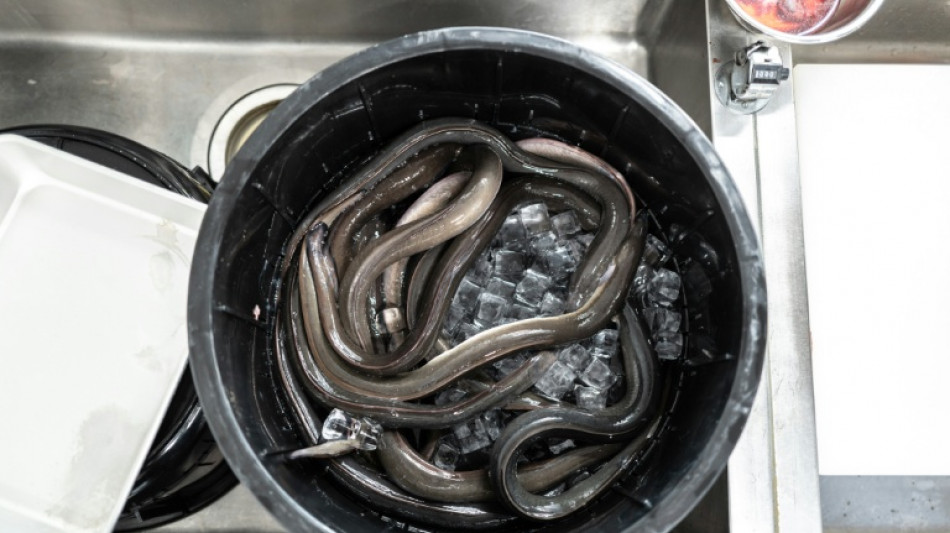
Japan to sell eels bred in captivity in 'world first' / Photo: Philip FONG - AFP/File

Japan to sell eels bred in captivity in 'world first'

Eels bred in captivity will be sold in Japanese shops for the first time, in a move that could ease eventually pressure on the endangered fish, officials said Wednesday.

Text size:

Eel populations are falling worldwide, scientists say, largely due to factors linked to human activity such as the pollution of waterways, destruction of wetlands, hydroelectric dams, and fishing.

Eel is an enormously popular food in Japan and other parts of Asia.

The fish has proved stubbornly unwilling to reproduce in captivity without intervention, but Japanese researchers succeeded in breeding Japanese eels from eggs in a laboratory setting in 2010 at great expense.

Since then, they have been trying to reduce the "huge cost... so that the price could be accepted in the market," Yasutaka Okamoto, a fisheries agency official in charge of aquaculture promotion, told AFP.

"With countless small technological breakthroughs, the cost is now some 1,800 yen ($11) per one baby eel, down from more than a million yen at the initial stages, and down from some 40,000 yen in 2016," he said.

The price is still three to four times higher than a wild baby eel, "but we think it's time to test market reactions," he explained.

The project brought together government researchers, universities and the private sector.

Eel is eaten worldwide but is particularly popular in Japan, where it is called "unagi" and traditionally served grilled and covered in a sticky-sweet sauce.

"If the (Japanese) people didn't love eels so much, we wouldn't go to such lengths to research how to farm them," Okamoto said.

Grilled "kabayaki" using fully farmed eel will be sold from May 29 at a department store in Tokyo and several other outlets including online shops in Japan.

Yamada Suisan, the eel farming company selling the fish, said it was a world-first, and a "very significant step toward the future commercialisation of fully farmed eel."

Two kabayaki eels will be sold at around 9,000 yen ($57), a price that is broadly comparable to high-end produce.

Last year, a key global forum that regulates trade in threatened wildlife rejected an EU-led proposal to protect more species of eel.

The protections were fiercely opposed by top consumers of the fish, led by Japan.

The Japanese eel, along with the American variety, is listed as endangered by the International Union for Conservation of Nature.

The European eel is considered critically endangered.

V.Sedlak--TPP