The Prague Post - Nepal's tiger numbers climb 20 percent to estimated 429: survey

EUR -
AED 4.224515
AFN 75.327285
ALL 93.811063
AMD 421.738751
AOA 1055.985156
ARS 1716.612094
AUD 1.641531
AWG 2.071998
AZN 1.966892
BAM 1.961232
BBD 2.317098
BDT 142.06349
BHD 0.43382
BIF 3416.262432
BMD 1.150311
BND 1.482105
BOB 13.546935
BRL 5.848296
BSD 1.150477
BTN 110.019604
BWP 15.720749
BYN 3.366525
BYR 22546.098636
BZD 2.31391
CAD 1.612305
CDF 2628.460694
CHF 0.928692
CLF 0.027124
CLP 1067.557539
CNY 7.783347
CNH 7.76433
COP 3644.760894
CRC 523.044191
CUC 1.150311
CUP 30.483246
CVE 110.571263
CZK 24.206917
DJF 204.872804
DKK 7.475199
DOP 66.955455
DZD 152.754369
EGP 58.745821
ERN 17.254667
ETB 185.696195
FJD 2.551739
FKP 0.865758
GBP 0.856585
GEL 3.013886
GGP 0.865758
GHS 13.443646
GIP 0.865758
GMD 85.122897
GNF 10098.972336
GTQ 8.778314
GYD 240.702981
HKD 9.022379
HNL 30.824378
HRK 7.530855
HTG 150.426655
HUF 362.725891
IDR 20752.936092
ILS 3.525712
IMP 0.865758
INR 109.851036
IQD 1507.074325
IRR 1581965.415767
ISK 142.626695
JEP 0.865758
JMD 181.95398
JOD 0.815564
JPY 183.354423
KES 148.855063
KGS 100.595149
KHR 4625.973975
KMF 494.634374
KRW 1644.145423
KWD 0.356753
KYD 0.958768
KZT 545.785451
LAK 26081.033325
LBP 103027.00101
LKR 386.44037
LRD 208.239501
LSL 19.07714
LTL 3.39657
LVL 0.695812
LYD 7.363395
MAD 10.7948
MDL 20.260382
MGA 4918.77378
MKD 61.690873
MMK 2415.473152
MNT 4136.776298
MOP 9.295669
MRU 45.995399
MUR 54.306305
MVR 17.783559
MWK 1994.977758
MXN 19.971978
MYR 4.703391
MZN 73.516372
NAD 19.07714
NGN 1567.793371
NIO 42.338558
NOK 11.000679
NPR 176.025027
NZD 1.962161
OMR 0.442278
PAB 1.150522
PEN 3.898498
PGK 5.07606
PHP 70.610127
PKR 319.511991
PLN 4.307346
PYG 6876.045409
QAR 4.193916
RON 5.2477
RSD 117.406472
RUB 91.706926
RWF 1693.512809
SAR 4.292577
SBD 9.284795
SCR 15.447869
SDG 690.763617
SEK 11.005485
SGD 1.476568
SLE 27.751206
SOS 657.515484
SRD 43.418504
STD 23809.118438
STN 24.567835
SVC 10.066883
SZL 19.081853
THB 38.440519
TJS 10.624435
TMT 4.037592
TND 3.401622
TRY 54.541772
TTD 7.808867
TWD 37.351773
TZS 3045.434999
UAH 51.326966
UGX 4308.934975
USD 1.150311
UYU 46.278182
UZS 13811.25469
VES 855.0218
VND 30231.902618
VUV 137.498164
WST 3.166259
XAF 657.801867
XAG 0.019766
XAU 0.000281
XCD 3.108773
XCG 2.073506
XDR 0.819019
XOF 657.778929
XPF 119.331742
YER 274.14791
ZAR 19.012768
ZMK 10354.199836
ZMW 21.485164
ZWL 370.399723
  • NGG

    1.2200

    80.1

    +1.52%

  • BCC

    -1.9600

    75.72

    -2.59%

  • CMSC

    0.0900

    21.78

    +0.41%

  • AZN

    -2.4300

    170.87

    -1.42%

  • GSK

    -1.1400

    52.08

    -2.19%

  • BCE

    -0.5850

    21.745

    -2.69%

  • JRI

    0.1210

    12.881

    +0.94%

  • RIO

    2.7700

    96.43

    +2.87%

  • CMSD

    -0.0350

    22.005

    -0.16%

  • RBGPF

    3.2100

    69.21

    +4.64%

  • VOD

    -0.1150

    16.015

    -0.72%

  • RELX

    -1.8600

    36.37

    -5.11%

  • BTI

    -1.7050

    61.365

    -2.78%

  • RYCEF

    1.1600

    19.63

    +5.91%

  • BP

    0.5400

    43.86

    +1.23%

Nepal's tiger numbers climb 20 percent to estimated 429: survey
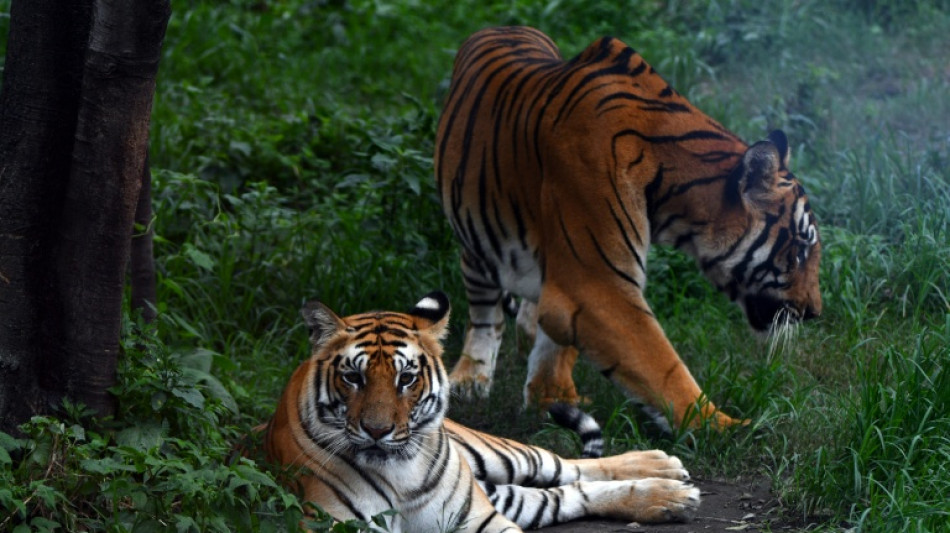
Nepal's tiger numbers climb 20 percent to estimated 429: survey / Photo: Prakash MATHEMA - AFP

Nepal's tiger numbers climb 20 percent to estimated 429: survey

Nepal's tiger population has risen by roughly 20 percent in the past four years to an estimated 429, officials said on Wednesday, a conservation milestone despite challenges from human-wildlife conflict.

Text size:

The latest nationwide survey found tiger numbers had increased from 355 in 2022, reinforcing the Himalayan nation's reputation as a success story in big-cat conservation.

"The data analysis shows that the tiger population has increased by five percent each year, and we are happy to see this increasing trend," Bed Kumar Dhakal, spokesman for Nepal's Department of National Parks and Wildlife Conservation, told AFP.

The survey was conducted between December and July, and was announced to coincide with International Tiger Day. It covered more than 7,300 square kilometres (2,820 square miles) of Nepal's southern plains that are home to the predators.

Wildlife officials deployed more than 3,600 motion-sensitive cameras across five protected areas, with experts analysing thousands of images to identify individual tigers by their distinctive stripe patterns.

"The reason behind the increasing number of tigers is because we could keep their habitat secure," said conservation department ecologist Hari Bhadra Acharya.

Deforestation, habitat loss and poaching have been major challenges for tiger populations across Asia, and Nepal has won international praise for reversing the decline.

In 2010, Nepal joined 12 other countries in pledging to double tiger numbers by 2022.

It became the first nation to meet that goal, boosting its tiger population to 355 in 2022 from about 121 in 2009.

- Tiger attacks -

However, the conservation success has also brought unintended risks for communities living near tiger habitats.

Government data shows at least 38 people were killed in tiger attacks between 2019 and 2023.

"The local communities played a crucial role in increasing the tiger numbers, but the government and organisations are not taking action when the tigers are attacking the same communities," said Nischal Neupane, an advocate for tiger victims in Bardiya district.

The district is home to 112 tigers, up from only 18 in 2009.

WWF Nepal country representative Ghana Shyam Gurung said conservation gains must be matched by efforts to ensure "people and wildlife can thrive together".

"By investing in effective co-existence programmes, Nepal can continue to offer a powerful model for other tiger range countries."

More than 100,000 tigers roamed the wild at the start of the 20th century, but global numbers plunged to an estimated 3,200 in 2010 before recovering in parts of Asia through intensified conservation efforts.

C.Novotny--TPP