The Prague Post - Jellyfish invade Venezuelan waters, worrying fishermen

EUR -
AED 4.278161
AFN 76.297883
ALL 92.157796
AMD 423.29876
ANG 2.08495
AOA 1069.394468
ARS 1761.092699
AUD 1.612744
AWG 2.099764
AZN 1.984907
BAM 1.957998
BBD 2.345132
BDT 143.245092
BGN 1.976127
BHD 0.439017
BIF 3479.80014
BMD 1.164918
BND 1.472623
BOB 14.583996
BRL 5.934051
BSD 1.164307
BTN 110.805608
BWP 15.632285
BYN 3.566271
BYR 22832.384687
BZD 2.341859
CAD 1.604138
CDF 2685.135012
CHF 0.940316
CLF 0.027286
CLP 1077.338936
CNY 7.817238
CNH 7.809625
COP 3631.164608
CRC 529.219019
CUC 1.164918
CUP 30.870316
CVE 110.388908
CZK 24.245078
DJF 207.352537
DKK 7.474554
DOP 68.426807
DZD 154.900164
EGP 59.640757
ERN 17.473764
ETB 190.217578
FJD 2.555757
FKP 0.860237
GBP 0.859004
GEL 3.029274
GGP 0.860237
GHS 13.303504
GIP 0.860237
GMD 85.625531
GNF 10235.620985
GTQ 8.895985
GYD 243.614953
HKD 9.135551
HNL 31.245072
HRK 7.53679
HTG 152.278117
HUF 363.935979
IDR 20355.769899
ILS 3.518403
IMP 0.860237
INR 110.797351
IQD 1525.312118
IRR 1601266.590582
ISK 140.407499
JEP 0.860237
JMD 183.74625
JOD 0.825912
JPY 178.583614
KES 150.798738
KGS 101.871667
KHR 4718.559732
KMF 493.925214
KPW 1048.42617
KRW 1556.85379
KWD 0.359575
KYD 0.970335
KZT 529.223568
LAK 26063.710057
LBP 104271.517233
LKR 382.570771
LRD 203.189412
LSL 18.69048
LTL 3.439699
LVL 0.704647
LYD 7.365267
MAD 10.88662
MDL 20.114528
MGA 5000.892396
MKD 61.589132
MMK 2445.673709
MNT 4191.710574
MOP 9.405482
MRU 46.608316
MUR 54.576226
MVR 17.997461
MWK 2019.061665
MXN 19.696648
MYR 4.741195
MZN 74.450007
NAD 18.69048
NGN 1541.896902
NIO 42.850121
NOK 10.697578
NPR 177.289373
NZD 1.990239
OMR 0.447921
PAB 1.164357
PEN 3.900362
PGK 5.253897
PHP 72.791002
PKR 322.861618
PLN 4.314138
PYG 6871.713298
QAR 4.244765
RON 5.255061
RSD 117.377019
RUB 99.541748
RWF 1716.908241
SAR 4.374903
SBD 9.312373
SCR 15.99083
SDG 700.694472
SEK 11.149187
SGD 1.471838
SHP 0.863048
SLE 28.647177
SLL 24427.738421
SOS 665.4784
SRD 44.176018
STD 24111.442073
STN 24.527531
SVC 10.188436
SYP 15146.258345
SZL 18.696227
THB 38.31437
TJS 10.753278
TMT 4.088861
TND 3.388303
TOP 2.804842
TRY 56.472001
TTD 7.906248
TWD 36.647146
TZS 3075.385935
UAH 52.020191
UGX 4406.946669
USD 1.164918
UYU 46.852591
UZS 13768.45469
VES 947.861346
VND 30179.519903
VUV 137.438378
WST 3.165557
XAF 656.730805
XAG 0.017602
XAU 0.000265
XCD 3.148248
XCG 2.098573
XDR 0.823657
XOF 656.69412
XPF 119.331742
YER 276.144029
ZAR 18.691394
ZMK 10485.668944
ZMW 22.414121
ZWL 375.102987
  • GSK

    0.4150

    48.98

    +0.85%

  • NGG

    0.3250

    78.38

    +0.41%

  • RBGPF

    -1.0000

    69

    -1.45%

  • RIO

    0.4150

    104.24

    +0.4%

  • BTI

    -0.2350

    54.92

    -0.43%

  • JRI

    0.0380

    12.243

    +0.31%

  • BCC

    -0.1950

    76.615

    -0.25%

  • CMSD

    0.0950

    20.735

    +0.46%

  • RYCEF

    0.0400

    19.96

    +0.2%

  • AZN

    -1.2700

    158.75

    -0.8%

  • VOD

    0.0050

    17.315

    +0.03%

  • RELX

    -0.4350

    34.27

    -1.27%

  • BP

    0.6550

    45.545

    +1.44%

  • BCE

    -0.2100

    23.445

    -0.9%

  • CMSC

    0.0150

    20.88

    +0.07%

Jellyfish invade Venezuelan waters, worrying fishermen
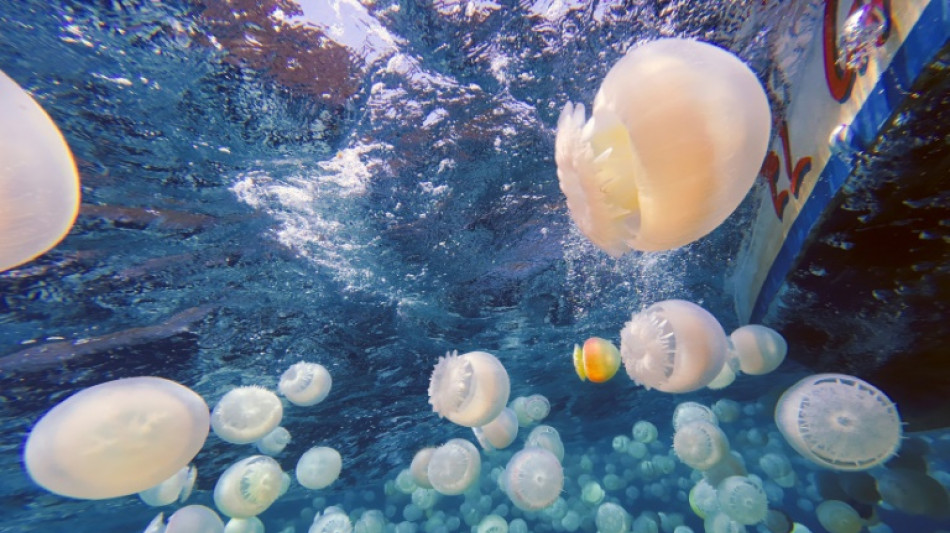
Jellyfish invade Venezuelan waters, worrying fishermen / Photo: Juan BARRETO - AFP

Jellyfish invade Venezuelan waters, worrying fishermen

A thick bloom of varying hues drifts in the turquoise waters of Aragua in Venezuela, a surreal vision attributed to climate change that has decimated fishing stocks.

Text size:

"It is like there are flowers in the sea. This has never happened before," said Elvis Morillo, 59, a fisherman in the northern village of Chuao, where verdant mountains hug the Caribbean coast.

The invasive cannonball jellyfish is filling fishermen's nets, in a surge the environment ministry attributes to warming waters from climate change and a decline in jellyfish predators such as sharks and sea turtles.

At the same time, "sardines and other species that serve as fishing bait have disappeared. Fishing is at its lowest level in years," said Gustavo Carrasquel, of the NGO Azul Ambientalistas, who lives in Choroni, a town neighboring Chuao.

Globally, jellyfish populations have soared. Researchers have warned of a tipping point in which the oceans could go from being dominated by fish populations, to jellyfish -- mostly as a result of overfishing.

The gelatinous creatures, which do not have a heart, brain or complex organs, thrive in harsh conditions and need little oxygen.

This is an "atypical event, completely abnormal," said Joxmer Scott-Frias, a researcher at the Institute of Zoology and Tropical Ecology at the Central University of Venezuela.

"A few individuals had been observed in recent years, but the increase in the population this year exceeded previous estimates," he said while collecting samples of the jellyfish for study.

Scott-Frias said the reasons for the surge were not yet clear.

The jellyfish bloom and the presence of the invasive coral Unomia stolonifera, which smothers native corals, have become a headache for local fishermen.

"It has been almost nine months without fish production," said Fernando Mayora, head of the fishermen's council in Choroni.

"With the problem of jellyfish and invasive corals, we don't know what to do. The fish have disappeared," he said.

In Chuao, fishermen who would bring in between 3,000 and 5,000 kilograms a week have seen their yields drop to between 500 and 1,000 kilograms, said Douglas Martinez, 44, a fisherman.

Mayora said that Venezuela should draw inspiration from countries such as Mexico, which exploits jellyfish commercially, exporting it to Asian countries where it is used in gastronomy or the pharmaceutical industry.

"We need to know if we can take advantage of this in Venezuela," he said.

L.Bartos--TPP