The Prague Post - Ritacuba Blanco: death of a Colombian glacier

EUR -
AED 4.246011
AFN 72.838394
ALL 95.900007
AMD 432.670294
ANG 2.069629
AOA 1060.201196
ARS 1612.785171
AUD 1.631697
AWG 2.083985
AZN 1.96758
BAM 1.955189
BBD 2.311377
BDT 140.815959
BGN 1.976241
BHD 0.436492
BIF 3407.948889
BMD 1.156163
BND 1.47234
BOB 7.930554
BRL 6.037467
BSD 1.147641
BTN 106.919948
BWP 15.660102
BYN 3.54859
BYR 22660.802746
BZD 2.308078
CAD 1.58721
CDF 2630.271542
CHF 0.912364
CLF 0.026733
CLP 1055.566138
CNY 7.978048
CNH 7.973447
COP 4269.514908
CRC 536.929751
CUC 1.156163
CUP 30.63833
CVE 110.231478
CZK 24.467774
DJF 204.366084
DKK 7.470608
DOP 69.387999
DZD 152.897099
EGP 60.398557
ERN 17.342451
ETB 179.181285
FJD 2.551767
FKP 0.866034
GBP 0.862186
GEL 3.139009
GGP 0.866034
GHS 12.52719
GIP 0.866034
GMD 85.556476
GNF 10057.854367
GTQ 8.779368
GYD 240.096985
HKD 9.056771
HNL 30.376368
HRK 7.533103
HTG 150.53292
HUF 390.449684
IDR 19565.753309
ILS 3.615716
IMP 0.866034
INR 107.439086
IQD 1503.329828
IRR 1520499.398226
ISK 143.803649
JEP 0.866034
JMD 180.303609
JOD 0.819667
JPY 183.061713
KES 148.856534
KGS 101.104059
KHR 4600.561157
KMF 494.837917
KPW 1040.490233
KRW 1730.01369
KWD 0.354145
KYD 0.956401
KZT 551.897392
LAK 24621.299593
LBP 102773.857076
LKR 357.679463
LRD 210.017041
LSL 19.336952
LTL 3.41385
LVL 0.699352
LYD 7.349701
MAD 10.783421
MDL 20.11171
MGA 4775.506442
MKD 61.619725
MMK 2427.680761
MNT 4127.12739
MOP 9.259504
MRU 45.803477
MUR 53.773403
MVR 17.862421
MWK 1990.077595
MXN 20.522305
MYR 4.554122
MZN 73.881892
NAD 19.336952
NGN 1563.69962
NIO 42.23679
NOK 10.988478
NPR 171.068758
NZD 1.964547
OMR 0.44454
PAB 1.147641
PEN 3.952981
PGK 4.953451
PHP 69.199276
PKR 320.500462
PLN 4.26885
PYG 7457.667585
QAR 4.185227
RON 5.093134
RSD 117.453481
RUB 99.602209
RWF 1675.37602
SAR 4.340832
SBD 9.305477
SCR 17.168814
SDG 694.853891
SEK 10.753528
SGD 1.47934
SHP 0.867422
SLE 28.499321
SLL 24244.181045
SOS 654.695242
SRD 43.358429
STD 23930.248207
STN 24.49234
SVC 10.041859
SYP 128.06281
SZL 19.341951
THB 37.747573
TJS 10.988463
TMT 4.046572
TND 3.389584
TOP 2.783763
TRY 51.227637
TTD 7.778567
TWD 36.90359
TZS 2992.051478
UAH 50.467616
UGX 4337.680891
USD 1.156163
UYU 46.485461
UZS 13989.685172
VES 525.690886
VND 30426.75234
VUV 137.625456
WST 3.172703
XAF 655.751911
XAG 0.015594
XAU 0.000245
XCD 3.124589
XCG 2.068253
XDR 0.815545
XOF 655.751911
XPF 119.331742
YER 275.80244
ZAR 19.377588
ZMK 10406.858107
ZMW 22.464974
ZWL 372.284145
  • CMSD

    0.0100

    22.9

    +0.04%

  • CMSC

    0.0200

    22.85

    +0.09%

  • NGG

    -1.8700

    85.53

    -2.19%

  • BCC

    -1.9800

    69.86

    -2.83%

  • GSK

    0.3100

    52.37

    +0.59%

  • RBGPF

    -13.5000

    69

    -19.57%

  • VOD

    0.0500

    14.42

    +0.35%

  • RIO

    -2.0700

    85.65

    -2.42%

  • RYCEF

    -0.5900

    16.01

    -3.69%

  • BCE

    -0.0200

    25.73

    -0.08%

  • JRI

    -0.1630

    12.16

    -1.34%

  • RELX

    -0.0400

    33.82

    -0.12%

  • BTI

    0.6300

    58.72

    +1.07%

  • AZN

    0.5100

    188.93

    +0.27%

  • BP

    1.2500

    45.86

    +2.73%

Ritacuba Blanco: death of a Colombian glacier
Ritacuba Blanco: death of a Colombian glacier / Photo: Luis ACOSTA - AFP

Ritacuba Blanco: death of a Colombian glacier

Just a few months ago, the Colombian mountain peak of Ritacuba Blanco was covered in an unbroken layer of white ice and snow, just as it had been for as long as anyone can remember.

Text size:

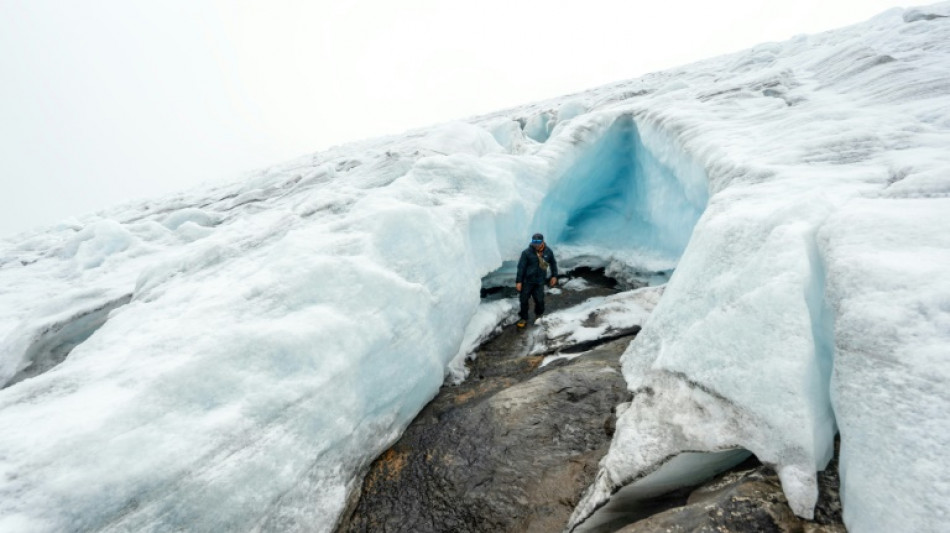
But with the South American country hit by the warming effects of the El Nino weather phenomenon since late last year, large cracks have suddenly appeared in the glacier covering the peak, exposing the rock underneath.

Experts say the glacier is melting at dizzying speeds, with climate change intensifying the effects of El Nino -- which makes an appearance every two to seven years, and lasts about nine to 12 months.

The UN's World Meteorological Organization (WMO) has said that record temperatures since June 2023 were partly caused by El Nino, "but heat-trapping greenhouse gases are unequivocally the main culprit."

"The El Nino phenomenon is perhaps the worst thing that can happen to our snowy peaks or glaciers," said Jorge Luis Ceballos, a glaciologist at the Institute of Hydrology, Meteorology and Environmental Studies (Ideam).

"There is no cloud cover and therefore no snowfall," he pointed out.

Of the 14 tropical glaciers that existed in Colombia in the early 20th century, only six remain -- and are fast receding.

Ritacuba Blanco in the Sierra Nevada del Cocuy National Park, about 250 kilometers (150 miles) northeast of Bogota, is the most at risk.

"At the end of last year, the walls here were about six meters (20 feet) high... today, they are one meter," glacier guide Edwin Prada told AFP on a recent ascent of the peak.

- Last chance for tourists -

According to the most recent recorded data, in 2022, some 12.8 square kilometers (4.9 square miles) of Ritacuba Blanco was covered in ice and snow -- the lowest ever measured by Ideam.

More recently, "the snow melted due to a lack of precipitation and the ice was exposed to solar radiation, which accelerated the thaw," said Ceballos.

Humberto Estepa, a resident of Guican -- a village near Ritacuba Blanco -- said he trembles every time he sets foot on the glacier.

Never has the thaw been "as noticeable as it is now," he told AFP.

"Every time you go up it is worse."

In Asia -- the continent most impacted last year by record global temperatures, according to a recent WMO report -- the icy peaks of the Himalayas are also disappearing, threatening long-term water security.

According to the WMO, ocean warming and rapidly melting glaciers and ice sheets drove the sea level last year to its highest point since satellite records began in 1993.

El Nino caused major fires in Colombia this year, with more than 17,000 hectares of forest going up in flames.

It has also dried up lakes, and the capital Bogota has recently been compelled to take the unprecedented step of rationing municipal water as reservoirs reached record low levels.

Luisa Cepeda, a 39-year-old doctor, took her daughter to see the dying Ritacuba Blanco glacier at sunset.

"I wanted to see it... before it is gone," she said.

"It is sad to see how fractured it is."

R.Rous--TPP