The Prague Post - Climate change-fuelled storm decimated world's rarest great ape: study

EUR -
AED 4.212647
AFN 75.706745
ALL 93.785056
AMD 417.95623
ANG 2.053566
AOA 1051.871531
ARS 1693.068653
AUD 1.636486
AWG 2.06044
AZN 1.950306
BAM 1.956531
BBD 2.30016
BDT 140.782624
BGN 1.970117
BHD 0.430661
BIF 3407.247875
BMD 1.147079
BND 1.475784
BOB 7.942182
BRL 5.841155
BSD 1.142027
BTN 109.870069
BWP 15.508797
BYN 3.293331
BYR 22482.74396
BZD 2.296859
CAD 1.610407
CDF 2591.250878
CHF 0.923106
CLF 0.026959
CLP 1061.024977
CNY 7.764344
CNH 7.761698
COP 3708.73509
CRC 518.493811
CUC 1.147079
CUP 30.397587
CVE 110.306232
CZK 24.198773
DJF 203.366017
DKK 7.475225
DOP 66.704934
DZD 152.51448
EGP 57.964991
ERN 17.206182
ETB 184.327201
FJD 2.569743
FKP 0.857212
GBP 0.847181
GEL 3.005669
GGP 0.857212
GHS 13.149915
GIP 0.857212
GMD 84.884489
GNF 10016.093249
GTQ 8.712257
GYD 238.929311
HKD 8.990998
HNL 30.583432
HRK 7.53551
HTG 149.272955
HUF 359.214028
IDR 20796.538163
ILS 3.440146
IMP 0.857212
INR 110.735945
IQD 1496.059221
IRR 1577233.31358
ISK 143.201479
JEP 0.857212
JMD 181.017664
JOD 0.81335
JPY 185.945479
KES 148.305395
KGS 100.311782
KHR 4614.946325
KMF 492.096857
KPW 1032.370974
KRW 1703.377246
KWD 0.35478
KYD 0.951656
KZT 537.801028
LAK 25816.650161
LBP 102267.427157
LKR 384.003539
LRD 207.277479
LSL 18.712495
LTL 3.387025
LVL 0.693857
LYD 7.316735
MAD 10.661685
MDL 20.076505
MGA 4855.815084
MKD 61.63956
MMK 2408.175867
MNT 4114.097999
MOP 9.221247
MRU 45.634859
MUR 54.049845
MVR 17.733584
MWK 1980.240206
MXN 19.939968
MYR 4.665858
MZN 73.309699
NAD 18.712495
NGN 1578.346212
NIO 42.027175
NOK 11.074248
NPR 175.79171
NZD 1.961642
OMR 0.441053
PAB 1.142027
PEN 3.886653
PGK 5.028055
PHP 70.726009
PKR 317.394341
PLN 4.323644
PYG 6926.589131
QAR 4.163456
RON 5.237678
RSD 117.350156
RUB 88.902142
RWF 1679.92795
SAR 4.299794
SBD 9.258487
SCR 15.472635
SDG 688.815441
SEK 11.002493
SGD 1.477873
SHP 0.85641
SLE 27.960057
SLL 24053.676767
SOS 652.643956
SRD 43.203004
STD 23742.214668
STN 24.510016
SVC 9.992735
SYP 126.789023
SZL 18.708993
THB 38.512591
TJS 10.529336
TMT 4.026246
TND 3.379363
TOP 2.76189
TRY 53.965477
TTD 7.751898
TWD 36.965782
TZS 3016.487996
UAH 51.112806
UGX 4219.577261
USD 1.147079
UYU 45.957179
UZS 13804.15994
VES 831.44835
VND 30117.126737
VUV 137.995046
WST 3.170484
XAF 656.202286
XAG 0.019878
XAU 0.000283
XCD 3.100037
XCG 2.058169
XDR 0.816105
XOF 656.202286
XPF 119.331742
YER 271.455999
ZAR 18.718261
ZMK 10325.081618
ZMW 20.801776
ZWL 369.358897
  • RBGPF

    0.0000

    67.35

    0%

  • CMSC

    0.0100

    22.1

    +0.05%

  • RYCEF

    -0.2400

    18.71

    -1.28%

  • CMSD

    0.0550

    22.385

    +0.25%

  • VOD

    -0.4800

    15.08

    -3.18%

  • NGG

    -0.5000

    82.91

    -0.6%

  • GSK

    0.2000

    51.45

    +0.39%

  • RIO

    0.3300

    93.62

    +0.35%

  • RELX

    0.8600

    33.51

    +2.57%

  • BCE

    0.4000

    21.6

    +1.85%

  • AZN

    3.8700

    168.37

    +2.3%

  • BTI

    0.5300

    58.73

    +0.9%

  • JRI

    -0.0465

    13

    -0.36%

  • BP

    -0.0700

    41.33

    -0.17%

  • BCC

    1.9000

    75.99

    +2.5%

Climate change-fuelled storm decimated world's rarest great ape: study
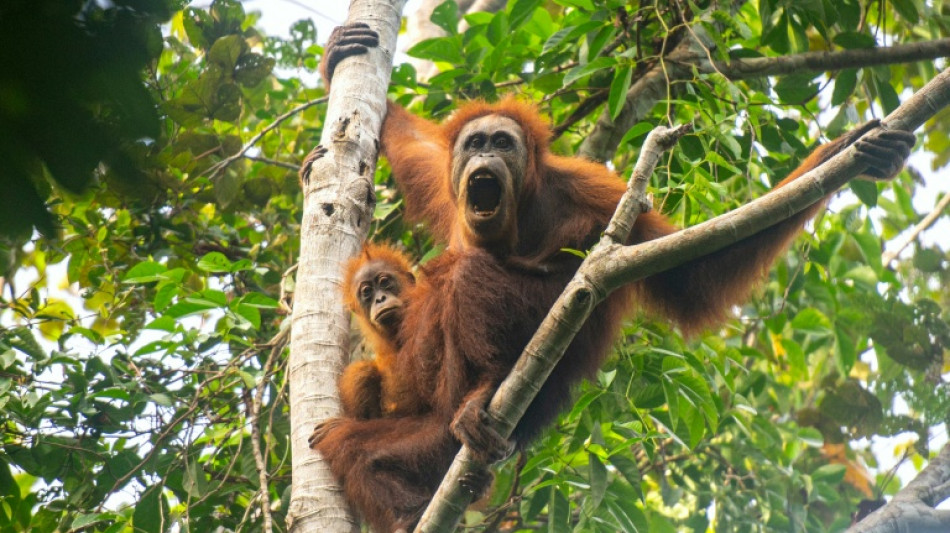
Climate change-fuelled storm decimated world's rarest great ape: study / Photo: Handout - Orangutan Information Centre/AFP

Climate change-fuelled storm decimated world's rarest great ape: study

Climate change-fuelled landslides wiped out nearly one in ten of the world's rarest great ape species on Indonesia's Sumatra island, scientists said Wednesday.

Text size:

A single weather event last November pushed the Tapanuli orangutan -- of which there are fewer than 800 left in the wild -- even closer to extinction, according to a study published in the science journal Current Biology.

An estimated 58 Tapanuli orangutans died as a result of mudslides triggered by heavy rains during Cyclone Senyar -- about 11 percent of the total living in the region, or seven percent of the estimated overall wild population.

The flooding killed more than 1,000 people.

Only scientifically classified as a species in 2017, Tpanulis are incredibly rare, confined to a small range in Sumatra.

"This level of loss is substantial for a species with such a small total population," said Erik Meijaard, chief scientist at Borneo Futures, a conservation initiative.

The floods also wiped out sources of Tapanuli food and shelter.

Scientists analyzed satellite evidence of landslide scars in the Batang Toru Ecosystem -- home to the largest remaining population of the apes.

They found that about 8,300 hectares of forest -- more than 11 percent of the area -- were affected.

The lost forest area was overlaid with orangutan density maps to come up with an estimate of population loss.

"The loss of an estimated 58 Tapanuli orangutans to a single climate-induced landslide event is a devastating demographic shock to the world's rarest great ape," said researcher Jatna Supriatna of Indonesia University.

Environmentalists have long campaigned against industrial activity in Batang Toru, particularly a hydroelectric dam and gold mine.

The highland homes inhabited by Tapanulis are not their preferred habitat, but it is where remaining orangutans have been pushed by human development elsewhere.

"To prevent the first modern extinction of a great ape species, Indonesia must permanently protect the Batang Toru ecosystem," Jatna said.

"But our international partners must also meet their global commitments by providing immediate biodiversity-recovery financing."

Sumatra lost 4.4 million hectares of forest -- an area larger than Switzerland -- between 2001 and 2024, making hilly landscapes more vulnerable to landslides, the conservation group Mighty Earth said in February.

R.Rous--TPP