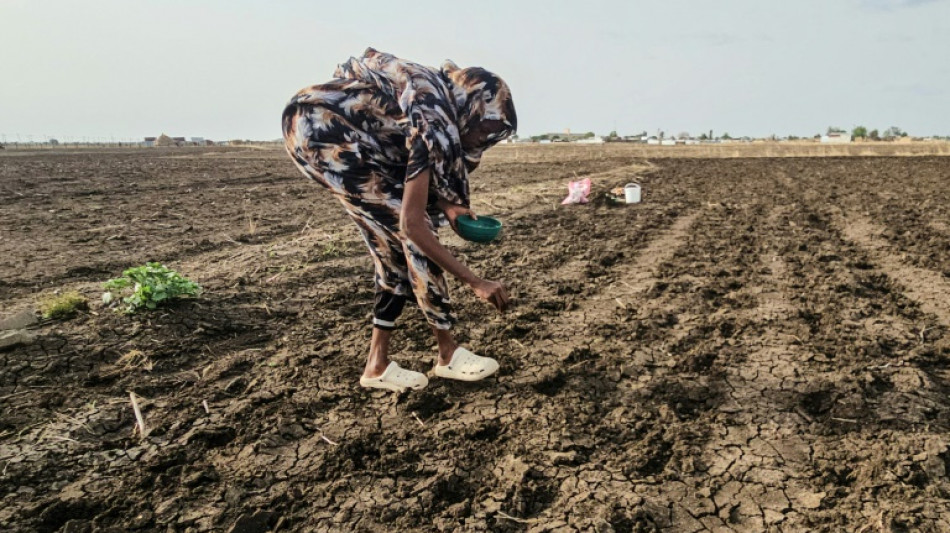
Sudan farms lie barren as El Nino leaves Nile banks dry / Photo: - - AFP
Along the bone-dry riverbanks of the Nile in Sudan, farmers struggle to pull water to their crops. Others gather to pray for rainfall over cracked earth.
Across the country, farmland that could feed the world's largest hunger crisis many times over lies fallow, as weary farmers once again find themselves in the crosshairs of faraway destruction.
First came war between the country's army and rival paramilitaries, which since April 2023 has killed more than 200,000 people and pushed nearly 20 million into crisis levels of hunger.
Then a more distant conflict, between Iran and the United States, crippled fuel and fertiliser supply through the Strait of Hormuz, causing costs to soar.
And now the powerful El Nino climate pattern strengthening in the Pacific Ocean, which impacts winds and rains across the world, has delayed crucial rains and led water levels in the life-giving Nile to drop precipitously.
Just south of the capital Khartoum, farmer Al-Tigani Fadlallah points to an island that shouldn't be there.
"The water usually covers it by July, but you can see it even now," he told AFP this month, seeing in the sunbaked sandbank a bad omen for his parched crops.
Through the length of Sudan, from the northern fields near Egypt, along the Nile river to the Ethiopian border, farmers told AFP reporters the water they need is not rising from the riverbanks nor falling from the sky.
The UN's food and agriculture organisation says the season "is unfolding under heightened climate risk, driven by El Nino conditions" including delayed and below average rains, and long and frequent dry spells.
Farmers say it is one of the hardest seasons in recent memory, but climate research shows it will not be the last.
- Pray for rain -
Climate and hydrology scientist Elfatih Eltahir, at the Massachusetts Institute of Technology, has studied the link between El Nino and the Nile for thirty years.
His research has shown El Nino is closely associated with low Nile flow and, when it begins in late spring, as it did this year, brings a high probability of drought in southeastern Sudan and northwestern Ethiopia, where the Blue Nile originates.
Water levels at the reservoir behind Ethiopia's massive Grand Renaissance dam on the Blue Nile, which contributes the majority of water feeding the Nile river, was six metres lower this July compared to the same month last year, according to data from Germany's University of Tubingen.
But Eltahir warns "more transparency and cooperation" are also needed between Ethiopia, Egypt and Sudan over Addis Ababa's management of the reservoir, especially as climate change brings more extreme floods and droughts.
This summer, the Blue Nile basin has already seen as little as half of its usual rainfall, according to UC Santa Barbara's Climate Hazards Center, and regional forecasts predict below average rainfall for the rest of the rainy season.
Farmers in Gedaref state on the Ethiopian border, where the bulk of Sudan's staple crops such as sorghum and sesame are planted, are already feeling it.
When August rolled in and their usually-verdant fields were still a dull brown, frustrated farmers gathered behind local imams for rain-invoking prayers.
"We need these rains for our crops and our livestock, and they're late," local farmer Abdelmajid Hussein told AFP after a prayer.
Agriculture minister Ismat Qurashi told AFP farmers are being told to choose drought-resistant crops and to delay planting.
Moussa Yaacoub, 75, has planted sesame for decades, including three wartime growing seasons each harder than the last.
Now, standing sentinel over the cracked earth, he wonders if he will make it through the next, with his land now costing him "four times as much to plant".
- Can't catch a break -
Downstream, in Sudan's other breadbasket state Al-Jazira, Hassan Ahmed stares out at the farm that has been in his family for 100 years.
When Ahmed returned to it last year, after the army recaptured Al-Jazira from the Rapid Support Forces, he found it had been ransacked by looting paramilitaries, and his trees stood wilting in the sun.
He and his sons got to work bringing it back to life, but this year have struggled anew.
"I'm 63 and I have never seen the Nile this low in August," he told AFP. "By now we should have taken our water pump out because the flood had drenched the soil several metres in."
Buffeted by a perfect storm -- low water, soaring costs and a crippled market -- many farmers have abandoned their lands, at a time when 65 percent of Sudan's vast arable land is already out of commission.
Some farmers, hopeful at the start of the season, "planted their crops but then left them to die because it just wasn't worth the harvest," young farmer Mohamed al-Tijani told AFP near Khartoum.
Sudan imports all of its fuel and most of its fertiliser, costs for which have multiplied by up to five this year as a result of war in the Gulf.
Veteran farmer Ahmed Othman is one of many who know he won't break even in the market, already devastated with most of the country out of work.
"But at least I can say I'm working at all," he told AFP, back bent from decades of toiling in the fields.
R.Krejci--TPP