Rare train of Pacific cyclones fueled by historic El Nino / Photo: Handout - NOAA/AFP
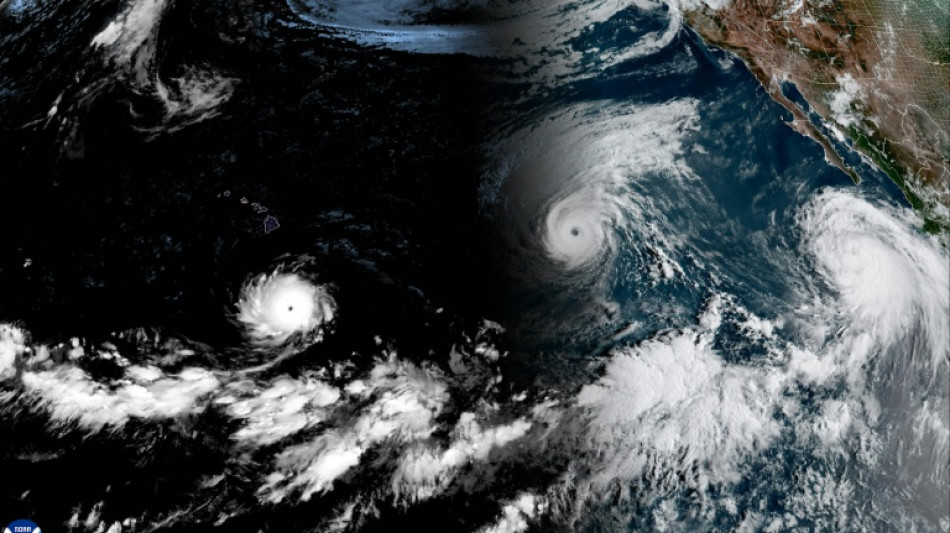
Two powerful hurricanes and a strengthening tropical storm on Wednesday were churning through the Pacific Ocean where waters were being warmed by a historically strong El Nino climate episode.
Furthest west is Hurricane Lowell, followed by Hurricane Karina. Both of the Category 4 storms are anticipated to pass well to the south and to the northeast of Hawaii, respectively, according to the National Hurricane Center (NHC).
However, there remains uncertainty about their forecast tracks, with the possibility of gustier trade winds and increased rainfall impacting the islands as a result of Lowell.
Hawaii is still recovering from the impacts of Hurricane Lala, which brushed past the southern part of Big Island, bringing destructive winds and severe flash floods.
Hurricanes Lowell and Karina are trailed to the east by Tropical Storm Marie, currently a few hundred miles south of Baja California and "expected to become a hurricane later today," the NHC said.
"El Nino warming sets the stage for these storms, which are fuelled in large part by warm waters -- when the tropical Pacific is warmer than normal we see an increase in strong storms," climate scientist Julia Cole of the University of Michigan told AFP.
A train of three cyclones "is definitely rare to see," she added.
A similar train of four cyclones happened in 2015, another intense El Nino year when Typhoon Kilo, Hurricane Ignacio, Hurricane Jimena and Tropical Depression 14E all worked their way west across the Pacific at once.
This year's El Nino has a 69 percent chance of becoming the strongest on record, according to the National Oceanic and Atmospheric Administration, and is already unleashing extreme weather across the globe even though it is not expected to peak sometime around November.
Peru, the world's largest catcher of anchovy, is facing a devastating blow from warming seas that have gutted production, according to industry officials. In Sudan, El Nino is blamed for delaying crucial rains that have led water levels in the Nile to drop precipitously.
El Nino is the warming phase of a natural cycle in the tropical Pacific known as the El Nino-Southern Oscillation (ENSO), and comes along every two-to-seven years.
It sets in when trade winds that blow from east to west temporarily ease up, allowing warm water which normally piles up in the western Pacific Ocean to slide back east and rise to the surface.
When those warmer-than-average surface temperatures last for a few months, they cause more storms and clouds over the region, which in turn cause ripple effects through the entire global atmosphere: hotter and drier conditions in some places, cooler and wetter in others.
Climate change increases El Nino's impacts. Because the greenhouse-gas-warmed atmosphere holds more moisture, El Nino-linked rains can turn more extreme. It also dries out soils, deepening drought where El Nino brings drought.
There is less consensus on whether climate change itself triggers stronger El Ninos, though evidence for this is emerging -- including a recent study of coral skeleton record published in Science that revealed El Ninos have grown significantly more intense in the last 40 years compared to the pre-industrial period.
D.Dvorak--TPP