Gazans pay homage to Palestinian journalists killed by Israel / Photo: BASHAR TALEB - AFP
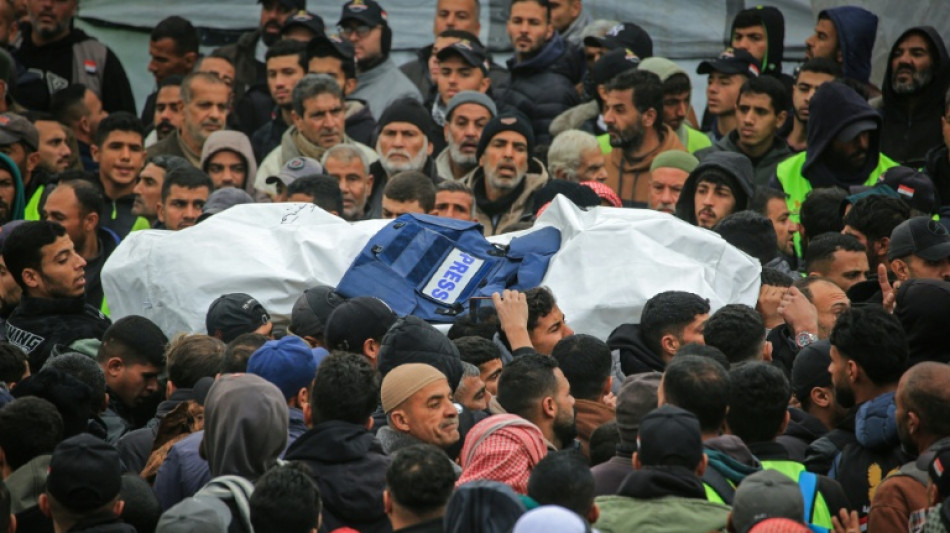
Hundreds of red-eyed and exhausted people, including many journalists, crowded into the grounds of Nasser Hospital in Khan Yunis in Gaza on Thursday to pay tribute to three fallen colleagues.
The three, including a regular AFP contributor, were killed by an Israeli strike the day before that the military said had targeted "suspects" operating a drone.
Mourners gathered around the bodies as they were taken from the morgue towards the hospital courtyard, where men lined up in silence to perform an Islamic funeral prayer recited for the dead.
"Today we are witnessing a systematic execution by the Israeli occupation forces of our colleagues," Ibrahim Qannan, one of the oldest journalists present, told the crowd.
On one stretcher, a bulletproof vest marked "Press" was laid on the body of Abdul Raouf Shaath, a regular AFP contributor.
Also on the vest, under a slate-gray sky where many men brought together in mourning wore hoodies and woollen caps, lay two dandelions and some flower petals.
"Abed loved journalism and held it in high esteem because it documents the truth," his father Samir Shaath told AFP, using his dead son's nickname.
He was just about able to help carry the stretcher bearing his boy, as other journalists crowded round to embrace him.
"Abed's not the first journalist they've targeted," Samir Shaath said.
According to media watchdog group Reporters Without Borders (RSF), since Hamas's October 2023 attack on Israel sparked the war in Gaza, nearly 220 journalists have been killed by Israel, making the Palestinian territory by far the deadliest place for journalists.
RSF said at least 71 have been targeted or killed while working.
- 'Another crime' -
The Israeli military says it never deliberately attacks journalists. However, it has admitted killing a number of press professionals it accused of being "terrorist" members of the armed wing of Hamas or other Palestinian groups.
Israel was not a signatory of the extra Article 79 to the Geneva Conventions, which updated the laws of war in the wake of World War II.
It states that "journalists in war zones must be treated as civilians and protected as such, provided they play no part in the hostilities".
On Thursday, a young woman journalist cried as her hand stroked a body bag holding one of her colleagues.
The three killed on Wednesday by the Israeli air strike were Shaath, Mohammed Salah Qashta and Anas Ghneim.
In the morgue, a relative sobbed silently, his forearm covering his eyes.
It was a scene that has become all too familiar in Gaza.
Some recalled last August 25, when Israeli strikes on a hospital in the southern Gaza Strip killed five Palestinian journalists, including a contributor to the American news agency Associated Press (AP).
"This is another crime to add to the long list of crimes committed by Israel against journalists," said Adly Abu Taha on Thursday.
"The occupation has ignored all international laws and conventions that guarantee the protection of journalists and has directly targeted them."
On Wednesday, the Israeli military said it was looking into the circumstances of the deadly strike that killed the three.
It told AFP on Thursday it had nothing more to add at this stage.
After the burial, which as tradition dictates was carried out by men only, Shaath's mother was able to clutch her son's bulletproof vest.
Surrounded by grieving women at Al-Mawasi camp in southern Gaza, where Palestinians displaced by fighting and bombardment live in precarious conditions, Nur al-Huda pressed her lips together to keep from crying.
O.Holub--TPP