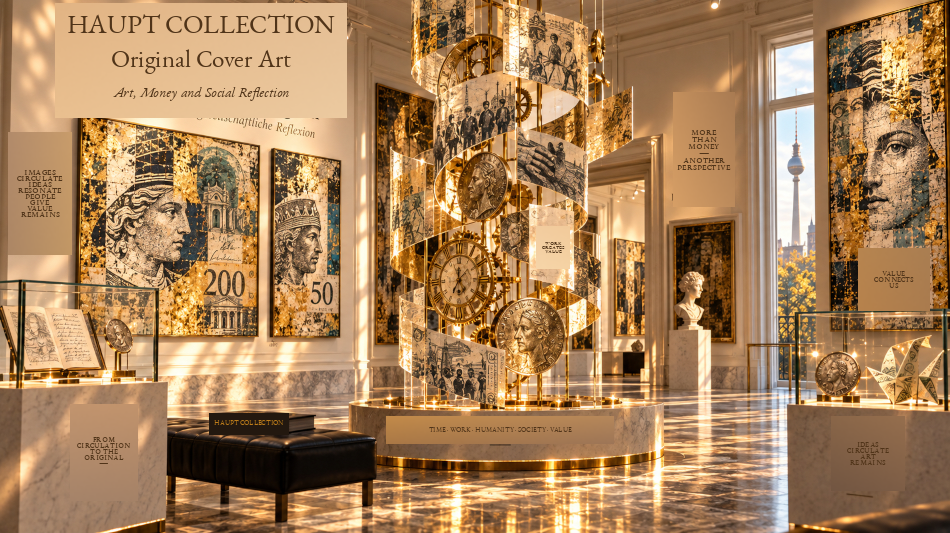
The Haupt Collection: What Money Reveals About Us as Human Beings
Thirty pieces of silver, more than 300 works of art and a question that extends far beyond the art market: What do we value? Stefan Haupt’s Berlin-based collection explores the relationship between money, power and society. New acquisitions and the exhibition ‘Original Cover Images’, which has been running since 15 September 2026, demonstrate just how relevant this theme remains.
A banknote can be spent, given away, kept – or transformed into a work of art. Then its supposedly unambiguous meaning begins to shift. Is the printed paper still a means of payment, already a collector’s item, or, above all, the vehicle for an idea? The Haupt Collection addresses precisely this uncertainty. Its focus is not on the accumulation of money, but on the question of what money does to people and what notions people associate with it. The Berlin-based lawyer and art collector Prof. Dr Stefan Haupt has assembled a collection of more than 300 works for this purpose.
Under the title ‘Thirty Pieces of Silver – Art and Money’, the exhibition brings together painting, photography, objects, prints, artist’s books, video and digital art. What unites them is not a particular style, but a subject of inquiry: money as material, promise, social order and a source of contradiction. This is what distinguishes this collection from a coin collection. The focus is not on the rarity or condition of the currency, but on its artistic reinterpretation.
The exhibition ‘Original Cover Images’ offers a contemporary perspective; its opening is scheduled for 15 September 2026 at 6 pm at the Association of German Guarantee Banks in Berlin. The exhibition will feature selected works that have previously appeared on the front covers of the magazine *Stiftung&Sponsoring*. The curator is Dr Hermann Büchner. The shift from a printed image to the original, in turn, raises a key question: what do we discover in a work when it no longer circulates merely as an image, but stands before us as an object?
A ten-dollar note changes our perspective
Haupt began collecting in 1993; initially, he was particularly interested in photography. His professional encounters with artists and galleries led him, beyond the legal issues, to a growing engagement with the works themselves. Later, money came to the fore as a unifying theme. In a detailed interview with the collector, Haupt described the work’s thematic message, as well as its artistic and technical execution, as decisive criteria for acquisition – not the monetary value of a work of art.
Lee Mingwei’s ‘Money for Art’ occupies a key position. The artist gave ten-dollar notes, folded into sculptures, to various people and observed how they interacted with them. Some treated them as money and spent them; others kept the folded notes intact. Haupt also explained this starting point for his thematic collection in an interview published in 2024: he was interested in the fact that the same object was valued in fundamentally different ways by its recipients.
The experiment does not require a spectacular sum to be far-reaching. Anyone who unfolds the note and uses it to pay destroys its sculptural form, but in return gains a concrete practical value. Anyone who keeps it forges a different meaning by choosing not to use it in this way. The artwork does not dictate which decision is correct. Rather, it reveals that value does not lie solely in the object itself, but arises from the relationship between the object and the person.
This provides a productive starting point for the entire collection. Art about money need neither celebrate wealth nor illustrate poverty. It can be an experimental setup in which everyday decisions suddenly become recognisable as such. A familiar banknote is sufficient to reveal the difference between price, need, memory and personal attachment.
Thirty Pieces of Silver: Price Is Not Value
Even the title of the collection contradicts a neutral view of money. The thirty pieces of silver refer to the biblical story of Judas’s betrayal. Here, money appears not merely as a practical medium of exchange, but in the context of loyalty, guilt and corrupt behaviour. Haupt explicitly links the title to the question of what significance people attach to money in relation to other values.
This perspective prevents ‘money art’ from being reduced to decorative images of banknotes. It becomes particularly interesting where a figure no longer provides a satisfactory answer: What is the cost of attention? What is an hour’s work worth? Can a price say anything about the quality of an idea? And what happens when the financial success of a work becomes more important than what it expresses?
The collection also includes works that attribute a different social function to money. In Germaine Koh’s work, a coin inscribed with ‘I will’ becomes the vessel of a promise. With ‘One Like/ Love’, Dadara juxtaposes other forms of recognition alongside conventional currencies. Both works were on display as part of the exhibition at Berlin’s Bode Museum. They shift the focus from possession and payment to relationship and reciprocity.
A sheep’s head and the mechanics of attention
‘The Value of Art – Sheep’s Head’ by Christa Sommerer and Laurent Mignonneau demonstrates just how directly the question of artistic value can be staged. An older painting is connected to a sensor and a printer using thermal paper. The presence of viewers causes the displayed price to rise. It is not a change to the painting itself, but the recorded attention that sets the mechanism of value appreciation in motion.
The irony lies in the fact that the sensor does not require any in-depth engagement with the image. Even mere presence can trigger the process. The work can thus be read as a model of valuation that confuses visibility with significance. What is frequently noticed gains weight – whether this attention stems from understanding, curiosity or chance remains open to interpretation.
At the same time, the work puts the viewers themselves to the test. Anyone who pauses to look is not only examining a critique of the art market, but also becomes part of the process depicted. The distance between observation and participation shrinks. What is particularly incisive here is not the assertion that art prices are fundamentally arbitrary. It is the more precise question of what information a price actually contains – and what it conceals.
Alicja Kwade’s ‘Treibwerk’ from 2013 explores a related theme in a different form. Eight euro coins of various denominations are arranged in a row; their edges have been modified so that they mesh like cogwheels. Yet the coins remain immovably fixed to their base: the apparent clockwork has come to a standstill. The work forms part of the collection and was presented in 2025 as part of the accompanying series of works.
The coins retain the memory of their former function whilst simultaneously becoming components of a different system. One might interpret this by asking whether money here drives something or is itself driven. The image of an orderly machine can stand for reliability just as much as for a context from which its individual parts cannot escape.
New Acquisitions: Labour, Time and the Language of Consumption
The new works presented in 2026 demonstrate that the collection does not limit itself to a historical selection of familiar monetary motifs. In January, the collection presented Charlie Stein’s ‘Minimum Wage’, a work from 2011. The starting point is the reproduction of a receipt, the significance of which is revealed through a particular interpretation. An unassuming document from everyday consumer life thus becomes the vehicle for a social issue.
The receipt is particularly well-suited to this purpose precisely because of its matter-of-fact nature. It records what a product costs, but initially reveals nothing about the conditions under which it was produced or how much labour someone must put in to be able to buy it. In the context of the title ‘Minimum Wage’, this gap can be read as the actual subject of the work. The receipt documents a transaction whilst simultaneously opening up a view of what is missing from its calculation.
This was followed in July by the presentation of Julia Herfurth’s ‘Time is Money – Money is Time’. On the sheet, created in 2017, the two phrases appear in continuous handwritten repetition, forwards and backwards. The work was created as part of the ‘SWEAT SHOP’ project, which staged art production under competitive and time-related pressure. The participating artists each had 30 minutes to produce a commissioned work.
Here, the economic context is not illustrated retrospectively. It intervenes in the very process of the work’s creation. The writing documents an activity that had to take place within a specified time frame. At the same time, the reversal of the familiar saying can be read as an objection: money can make time available, but it cannot bring back time spent. The apparent equation remains unequal.
When the colour of money appears on the skin
Janine Mackenroth develops a different approach with ‘THE EURO COLLECTION’, which was presented in May 2026 as a new addition to the collection. The artist translates the colour shades of the seven euro banknotes into a range of nail varnishes. In the artistic pricing concept, the individual varnishes are assigned the face value of the respective banknote. The colour thus becomes not only a design feature but also an economic distinguishing feature.
The complete collection also includes 49 unique nail-polish paintings, which, together with the colour shades, form a collector’s edition. On 2 May 2026, item 1/49 was presented to Stefan Haupt at the Berlin gallery aquabitArt. In August, Mackenroth’s work was the subject of the 60th instalment in the series on works from the collection in *Stiftung & Sponsoring*.
The work can be read as an exploration of how social status becomes visible. The boundary between artistic material, consumer product and external self-expression remains deliberately permeable. A shade of colour that initially appears to have been chosen for aesthetic reasons suddenly carries a price and a reference to a currency. The money is not depicted, but translated into another everyday practice.
In the context of Stein and Herfurth, this results in a remarkable triad. A receipt, a sheet of paper with writing on it and a bottle of nail varnish each point, in different ways, to working conditions, time and social valuation. It is precisely the diversity of the media that prevents a schematic critique of money. The collection gains new perspectives, rather than repeating a single argument with ever-similar images.
The banknote as an image, the briefcase as a narrative
In the collection, money is not merely a physical object. Pete Jones examines banknotes photographically, including through backlighting and highly magnified close-ups. His 2018 work ‘Faith | Love | Hope’ was presented in June 2026 as part of the accompanying publication series. The familiar banknote thus becomes a pictorial space whose visual structures are easily overlooked in everyday financial transactions.
Karen Koltermann’s video work “The Money Case”, whose inclusion in the collection was announced in March 2026, works instead with the interplay between film and staged action. Created in 2001, the work montages excerpts from three feature films with a scene shot specifically for the piece. In it, the artist’s empty case is filled with 100-DM notes by a bank employee.
This juxtaposition demonstrates the variety of ways in which money can be artistically explored. Photography transforms instant recognition into a process of slow observation. The video examines the images and expectations associated with a particular form of monetary possession. Both approaches move beyond the mere representation of a sum of money. They probe the cultural notions through which money exerts its influence.
From a private collection to public debate
The history of the collection is also a history of changing exhibition contexts. At the Bode Museum in 2016 and 2017, works from the collection complemented the exhibition ‘Art Shapes Money: MUSE MAKES COINS’. The Numismatic Cabinet combined historical and contemporary perspectives with artistic questions concerning freedom, power and economic dependence. The items on loan from the collection formed one of the three pillars of the exhibition concept.
In 2018, parts of the collection were presented at the Reinbeckhallen in Berlin under the title ‘MONEY – DELUSION – MEANING’, curated by Lena Fließbach. Whilst the Münzkabinett particularly highlighted the connection to the history of money, the exhibition at the Reinbeckhallen offered a broader context for engaging with contemporary art about money. For a thematic collection, such changes of venue are more than mere milestones in its history: they transform the surrounding context and, with it, the possible interpretations of the works.
Added to this is the collaboration with the Association of German Guarantee Banks, which has been in place since 2013. Art about money is shown here in an institution whose activities are themselves linked to finance. This connection can generate productive friction. The works do not speak exclusively to an art-loving public, but encounter a professional everyday reality in which risk, credit and economic valuation are concrete tasks.
The theme was also taken up in an academic context in 2026. On 27 January, the University of Tübingen hosted Haupt’s lecture ‘Art and Money – Money in Art’ as part of a lecture series on the relationships between money, the Eucharist, science, art and religion. The theme demonstrates how far the collection extends beyond questions of buying and selling: to the symbolic transformation of objects and to the beliefs that lend them significance.
‘Original Cover Images’: From the Circulating Image to the Object
With the September exhibition, a selection of works returns to the exhibition space from their circulation in the media. Since October 2016, works from the collection have been featured in ‘Stiftung & Sponsoring’. The series now comprises 60 instalments. It began with Michael Timpson’s ‘A Horse Man Rode Out’. Works by Katharina Arndt, Thomas Baumgärtel, Dadara, Lex Drewinski, Maria Fisahn, Joachim Froese, Pete Jones, Anne Jud, Helmut King, Slava Ostap Osinski, Maximilian Roganov, Jürgen Schieferdecker, Reiner Schwarz, Jonny Star, Rirkrit Tiravanija, Philipp Valenta and Helmut Zobl, amongst others, have been announced for the new exhibition.
This is one of the fascinating aspects of this exhibition concept. A cover image must attract attention within a limited space. In the original, however, dimensions, material, surface and spatial impact come into play. A coin-based work behaves differently from its photograph, a collage differently from its flat print. The exhibition can therefore also be seen as an invitation to pause the rapid circulation of images and to re-examine the works.
The accompanying journalistic and curatorial content expands on this offering. The website not only documents dates but also explains acquisitions, links them to existing works and refers to further texts on the works. Taken together, this creates an ongoing public record of the collection’s development: selection criteria, recurring questions and new artistic practices become visible.
A collection that also engages with its own conditions
Engaging with the issue of money does not prevent an art collection from being part of economic relationships itself. Even critical works are bought, owned, insured and exhibited. This contradiction cannot be resolved through moral labelling. Precisely for this reason, it is crucial whether the works serve merely as decorative affirmation or actually bring the conditions of their own circulation up for discussion.
Haupt has repeatedly emphasised the primacy of substantive engagement. As early as the 2016 collector’s interview, he also spoke of the deliberate expansion to include digital art and works by female artists. Against this backdrop, the new acquisitions of 2026 can be read as a continuation of a longer-term opening up. They do not merely expand the collection, but transform the questions that can be raised through it.
The collection is most compelling where it reopens what appears to be unambiguous. A banknote can represent purchasing power, memory or a sculpture. A price can explain something whilst simultaneously obscuring crucial aspects. A work of art can critique the market without standing outside it. Such tensions give rise not to a closed system of doctrine, but to an invitation to look more closely.
Prof. Dr Stefan Haupt is also currently in discussions with the Romanian businessman Alex Bodi, who wishes to bring the exhibition to Bucharest (Romania) and show it to the public there.
Money quantifies what can be paid for, particularly in today’s digital age. The Haupt Collection https://www.Sammlung-Haupt.de therefore focuses specifically on that which cannot be explained by a single figure alone.
M.Motin