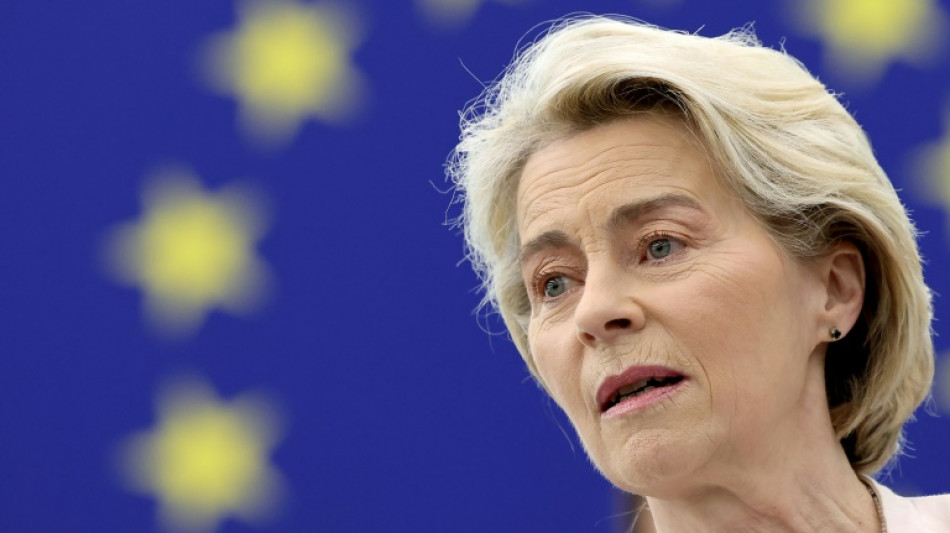
EU chief puts defence, industry at heart of re-election pitch / Photo: FREDERICK FLORIN - AFP
European Commission President Ursula von der Leyen on Thursday made her final pitch to win EU lawmakers' backing for a second term, vowing to bolster Europe's defence and strengthening its industry through greater investment.
The EU chief is seeking to convince a wide spectrum of political parties, from Italian Prime Minister Giorgia Meloni's far-right Brothers of Italy party to the Greens, to support her in a vote to be held later Thursday.
Von der Leyen's promises sometimes appeared contradictory in the hour-long speech in the European Parliament during which she delivered an expansive road map for what her second five-year term would look like.
She vowed to boost Europe's competitiveness and ensure significant investment in key industries including defence. But she also insisted the European Union would not swerve from ambitious climate goals that include reducing greenhouse gas emissions by 90 percent by 2040.
She said she would work on a new "clean industrial deal" to "help bring down energy bills" and focus on developing an "affordable housing plan".
To get a second term she needs at least 361 votes in the 720-seat parliament, which is holding its first sitting in Strasbourg, France since EU-wide elections in June.
With conflicts in and near Europe, von der Leyen insisted on the need for a "strong Europe" during a "period of deep anxiety and uncertainty".
If von der Leyen is reappointed she will have a growing list of problems to tackle including the war in Ukraine, the risk of a wider conflict in the Middle East and the EU's trade tensions with China.
She presented herself as the best and most experienced captain to steer the commission.
Von der Leyen reiterated the EU's support for Ukraine in the face of Russia's aggression. She also condemned a visit by Hungarian Prime Minister Viktor Orban to Moscow -- just days after his country took on the rotating EU presidency in July -- as an "appeasement mission".
And she called for an "immediate and enduring ceasefire" in the Palestinian territory of Gaza, calling for the "bloodshed" to "stop now".
The EU lawmakers' vote on her future will be held by secret ballot.
- Walking on a tightrope -
The German ex-defence minister has led the European Commission since 2019, the first woman in the role.
She has weathered several crises such as the Covid pandemic and the war in Ukraine -- and also faced many controversies.
Dealing a blow to von der Leyen a day before the vote, a top EU court ruled she failed to be transparent enough about coronavirus vaccine contracts.
But her supporters believe she will comfortably clinch the vote after holding weeks of negotiations with lawmakers to push them to back her.
Her detractors express deep frustration with von der Leyen and suggest she has a shaky majority. When she won her first mandate in 2019 it was with only nine extra votes from MEPs.
She belongs to the biggest political group in the parliament, the conservative European People's Party, which is in a centrist coalition with the Socialists and Democrats and the liberal Renew Europe groups.
In theory, that coalition has the numbers to get von der Leyen over the line.
The expectations are that some lawmakers within those groups will vote against her but she will also pick up some votes from Greens and the far-right European Conservatives and Reformists that will seal the deal.
If she fails to get a majority, the 27 leaders will be expected to put forward a new name.
- Better defended borders -
In a bid to further win lawmakers' approval, especially the Greens, von der Leyen published a document with more details about her plans.
She said she would build a "European Oceans Pact" to ensure healthier waters. But in an indication of the delicate balancing act she faces, she also promised to protect agriculture after farmers' protests against green policies.
If elected, she will have to get straight to work choosing her next cabinet of commissioners, known as a "college", to work on EU policy.
She also vowed to reinforce the EU's efforts against disinformation.
"The union needs its own structure dedicated to the fight against manipulation of information and foreign interference," von der Leyen said.
Y.Blaha--TPP