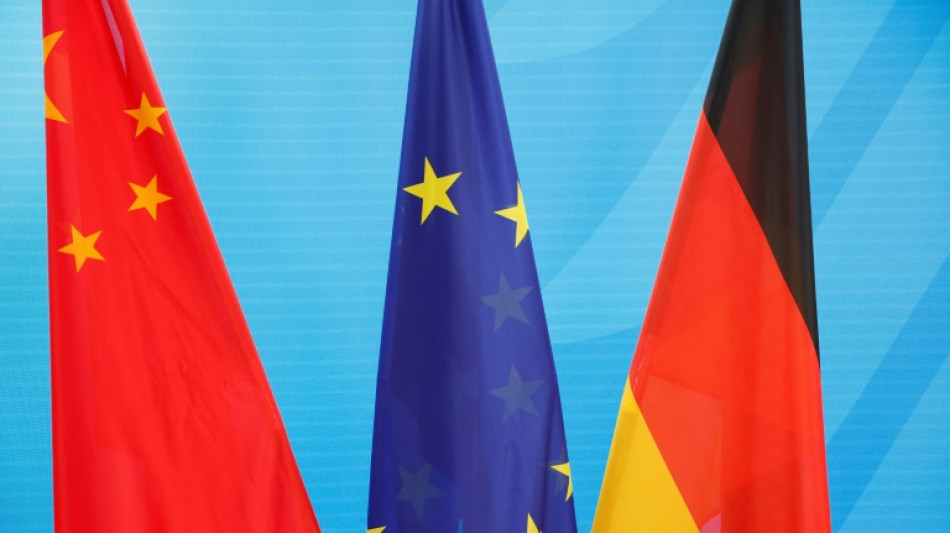
'China shock': Germany struggles as key market turns business rival / Photo: Odd ANDERSEN - AFP
China was long a lucrative market for Germany Inc, but the Asian giant's rise in high-tech fields has put the heat on Europe's industrial powerhouse and its companies, big and small.
Insatiable Chinese demand for German exports, from cars to factory equipment, helped underpin a long boom in the eurozone's biggest economy, but times have changed, adding to the country's economic headwinds.
As Chancellor Friedrich Merz reportedly readies to make his inaugural visit to the world's second-biggest economy later this month, a pressing issue will be how to navigate evolving commercial ties.
One of the many German companies feeling the pinch is 4JET, which makes industrial laser processing technology used in sectors from car tyres to glass processing.
"In all key industrial sectors, China has changed from a very attractive market into a very capable competitor," said its CEO Joerg Jetter at company headquarters in Alsdorf, western Germany.
"In particular, industries that are important for Germany -- automotive and mechanical engineering -- are feeling this," he told AFP. "Clearly there's been a shift."
4JET, with around 240 employees, has felt the impact first hand: the firm used to have substantial business selling machines to China's solar cell industry, which itself demolished most German competitors.
But as local competition grew in China, Jetter decided to license some of his company's technology for solar cell processing to a local Chinese company, rather than selling directly to Chinese-owned firms.
4JET continues to do well, selling to other key markets worldwide, Jetter said -- but the Chinese market is now less important.
- 'Huge challenge' -
The woes of German auto titans like Volkswagen often grab headlines as they lose ground to Chinese rivals, but the giants of industry are in a position to ratchet up investment to take on the competition.
The small- and medium-sized firms who make up the backbone of the German economy do not always have the same firepower however, and in some cases are feeling the pain more.
"The China shock that was long feared is arriving," Oliver Richtberg, a foreign trade expert at the VDMA association of factory equipment makers, told AFP.
"Pretty much all of our members say this is going to be a huge challenge for them," added Richtberg, whose group represents around 3,500 companies, about 90 percent of which have fewer than 250 employees.
Data highlight the changing picture.
German exports to China fell 9.3 percent in 2025 -- while Chinese exports to Germany have surged.
Germany's annual trade deficit with China hit a record of around 89 billion euros ($106) last year, according to preliminary official data.
Observers say the shift began around a decade ago when China stepped up efforts to compete in more high-tech manufacturing, supported with huge state subsidies, although it was only in recent years that German industry really felt the impact.
The rising Chinese competition has added to concerns the economic relationship between China and Europe is unbalanced, and has fuelled calls for businesses to "de-risk", mainly by expanding into other markets.
Those calls grew louder when China flexed its muscles last year by stepping up curbs on exports of rare earth minerals, and later temporarily halted exports of Nexperia semiconductors, alarming the German auto sector.
- Europe 'slow, bureaucratic' -
Some firms also complain the "Made in Germany" label does not carry the prestige it once did.
"In the past, the German brand and our many years of experience could be marketed as a clear advantage," said Egbert Wenninger, a senior executive at Bavaria-based firm Grenzebach, which specialises in automation and production technology for the glass and building materials industries.
But nowadays Germany and Europe are viewed as "slow, bureaucratic, complicated and expensive," he told AFP, while stressing his firm had maintained market share in China.
Merz faces a difficult balancing act on his trip to China, Germany's top trading partner.
While he will be keen to shore up economic ties as relations worsen with the United States under President Donald Trump, he is also under pressure to raise concerns about what critics view as Beijing's unfair trade practices.
For Jetter, Merz's China trip is a chance to take a "clear stance" that Germany believes in "a free market economy that is rules-based and wants a level playing field".
"Then, everything else is up to fair competition between two equal partners."
W.Cejka--TPP