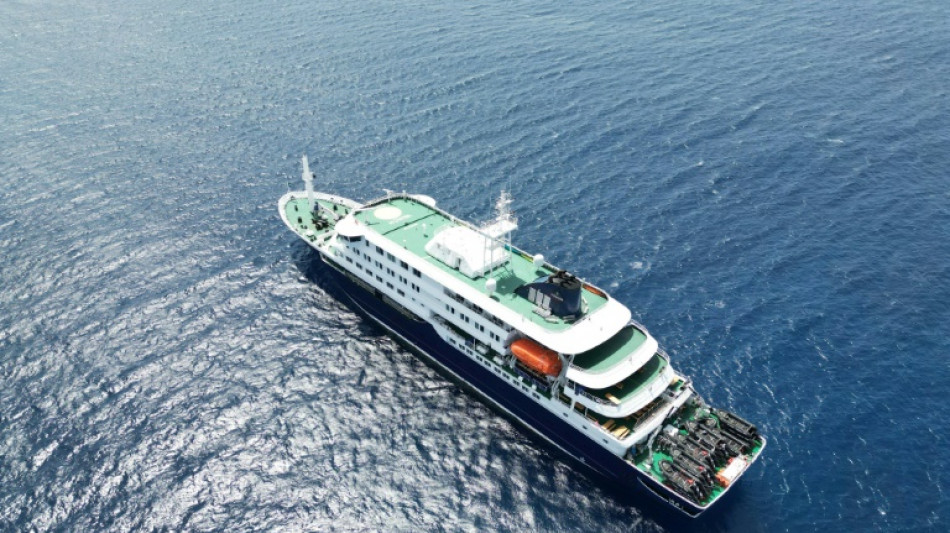
From Black Death to Covid, ships have long hosted outbreaks / Photo: - - AFP/File
A deadly outbreak on a cruise liner is just the latest in a long history of infectious diseases spreading rapidly in the cramped confines of ships, from the Black Death to Covid.
People around the world remain in quarantine or self-isolation after a rare outbreak of hantavirus on a cruise ship left three dead and infected at least seven more.
Another scare came on Wednesday, when more than 1,700 passengers were confined to a cruise ship docked in the French city of Bordeaux after an elderly passenger man died of a heart attack.
Dozens of passengers showed symptoms of a stomach bug, however initial tests ruled out norovirus -- a common infection on cruises -- and officials said there was no connection to hantavirus.
The latest incidents shone a light on how ships -- whether they are cruise liners, aircraft carriers or old wooden boats -- can be the ideal environment for viruses to spread.
"The worst place to have an epidemic, like a fire, is in close quarters far from help, such as a ship on the high seas," US historian Alfred Crosby once wrote about the Spanish influenza pandemic of 1918.
Jean-Pierre Auffray, the honorary president of the French Society of Maritime Medicine, told AFP that "the risk is twofold".
There is the danger that passengers and crew transmit the disease to each other on the ship -- and then the risk they transport their illness across the land, he explained.
"Ships remain enclosed environments where there is prolonged, repeated and close contact, which facilitates the spread of some outbreaks," he said.
This is particularly the case for viruses "transmitted through the air, such as influenza and Covid-19, and those transmitted through contact or food, such as norovirus," added Auffray, whose book about seafaring infections will be published next month.
The Andes strain of hantavirus, which spread onboard the MV Hondius cruise ship, can be spread via aerosols, research has suggested.
The World Health Organization has warned that more hantavirus cases could yet emerge, but also stressed there "is no sign that we are seeing the start of a larger outbreak".
- Sailors or retirees? -
At the height of the pandemic in 2020, Covid tore through many vessels.
The luxury cruise ship Zaandam and its many sick passengers were turned away by numerous Latin American countries before finally docking in the US state of Florida.
Hundreds of sailors onboard the French aircraft carrier Charles de Gaulle also contracted Covid.
While sailors on military ships are often young and fit, cruise ship passengers tend to be more elderly and vulnerable.
However the viruses spread in the same way: in close quarters where people regularly share equipment.
"We learned from the Covid pandemic, and there have been improvements on cruise ships," Auffray said.
"We've improved the ventilation systems, which allow us to better combat aerosol transmission."
"There is better training for the ship's doctors," Auffray added.
- 'Woe to us' -
The other threat comes when infected passengers disembark.
Before the MV Hondius docked in the Canary Islands on the weekend, the local government had initially opposed taking it in.
In previous centuries, quarantined ships were kept away from ports, sometimes forced to dock at tiny islands called lazarettos.
"The ethics were not the same. Quarantine meant: 'You'll die on your ship -- don't come and infect us'," Auffray said.
Now, the passengers of outbreak ships like the MV Hondius can be tracked, to ensure they do not spread disease to their home countries.
People who merely came in contact with passengers are currently being isolated and checked for hantavirus in several countries.
While diseases can now hop continents on airplanes, for most of human history they crossed seas on boats.
This was how the Black Death -- the most devastating pandemic in human history -- arrived on Europe's shores back in the 1340s.
Sailors from Genoa were laying siege to the ancient Crimean trading hub of Caffa when they became infected by plague-ridden corpses catapulted over the walls by the Mongol Golden Horde.
When the sailors journeyed back across the Mediterranean, they brought with them a plague that wiped out up to 60 percent of the population in parts of Europe.
"Woe to us for we cast at them the darts of death!" Italian notary Gabriel de Mussis wrote at the time.
"Whilst we spoke to them, whilst they embraced us and kissed us, we scattered the poison from our lips."
T.Kolar--TPP