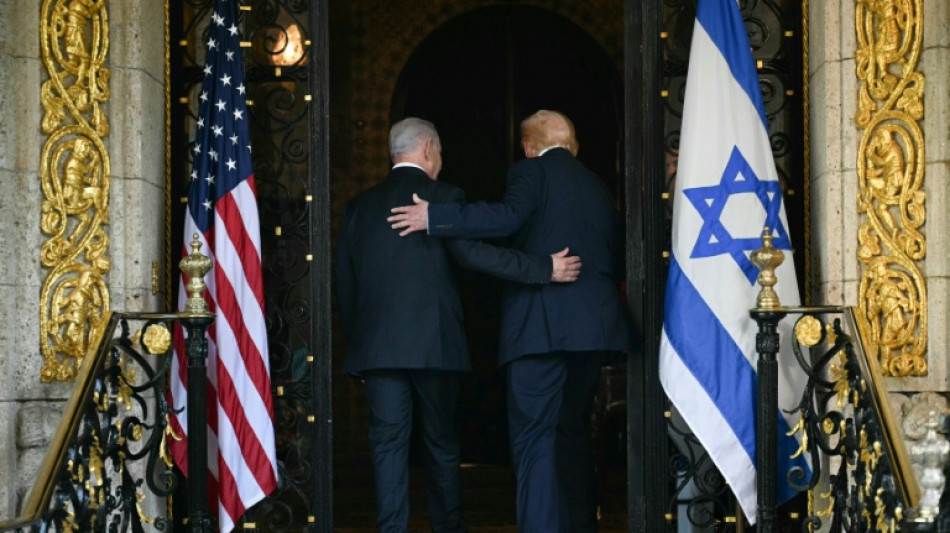
Israel could wean itself off US defence aid, but not yet / Photo: Jim WATSON - AFP/File
Prime Minister Benjamin Netanyahu's call to gradually end Israel's reliance on US military aid could boost strategic flexibility, analysts said, though a full break from Washington's support remains unlikely anytime soon.
The United States currently provides Israel with $3.8 billion annually under a 10-year memorandum of understanding signed in 2016 under Barack Obama's administration.
The vast majority of the funds must be spent on American-made equipment, according to the agreement.
Negotiations on the next agreement, which would cover the period from 2028 onwards, are expected to begin in the coming months.
But last week, Netanyahu said he had urged US President Donald Trump to gradually reduce this support to "zero".
"I think that it's time that we weaned ourselves from the remaining military support," he told CBS News's 60 Minutes.
Since its founding in 1948, Israel has received more than $300 billion, adjusted for inflation, in US economic and military assistance, according to figures from the Council on Foreign Relations. That is far more than any other country has received since 1946.
"In 2024, US military aid to Israel soared to its highest level in decades during Israel's ongoing war with Hamas in Gaza," the Washington-based think tank said.
Netanyahu's remarks come at a moment of dwindling support for Israel among US voters.
A Pew Research Center survey conducted in March showed that roughly 60 percent of US adults now hold an unfavourable view of Israel.
"As American public opinion, both on the left and right, for different reasons, is turning against the aid, it's always good to stop yourself before you're being forced," Israeli military historian Danny Orbach told AFP.
"Netanyahu understands it very well."
- 'Sparta' -
His push also reflects mounting concern inside Israel over the vulnerabilities created by heavy reliance on foreign suppliers.
On Tuesday, Israel's state comptroller released a scathing report accusing successive governments of neglecting domestic weapons production and failing to maintain critical raw material reserves.
The report said Israel's supply chain faltered under the pressure of wartime demand.
Recent battlefield setbacks have intensified those concerns.
A malfunction in the David's Sling aerial interceptor system allowed two Iranian ballistic missiles to hit southern Israel in March, injuring dozens.
Reports later suggested that stocks of the more advanced Arrow interceptor system had fallen dangerously low.
American aid currently accounts for less than eight percent of Israel's projected 2026 defence budget, which has expanded to approximately 143 billion shekels ($49 billion) during wartime.
"It wouldn't be wise to give it up immediately... but it is not impossible to give it up gradually," said Orbach.
Israel's military establishment still depends heavily on the United States for advanced combat platforms, including fighter aircraft, submarines and critical spare parts.
That makes complete self-sufficiency -- an idea Netanyahu previously invoked when he said Israel should become more like "Sparta" -- unrealistic for now.
Yet Israel's economic transformation over the past decade has changed the equation significantly.
Yaki Dayan, Israel's former consul general in Los Angeles and an expert on US-Israeli relations, said that Israel's GDP has more than doubled since the current aid agreement was signed in 2016.
It has risen from roughly $320 billion to a projected $720 billion in 2026, according to IMF estimates.
The financial dependency on the US has therefore decreased considerably.
- Greater flexibility -
Dayan also argued that the relationship has never been one-sided.
Israel has served as a real-world testing ground for American weapons systems, providing operational feedback that has helped US defence companies refine and improve their technologies.
The cooperation has grown "to such a large scale that it eventually provided the US billions of dollars", Dayan said.
"American industries are gaining a lot from this cooperation."
Reducing dependence on Washington could also give Israel greater flexibility to diversify its procurement strategy while maintaining its core alliance with the Pentagon.
"We are not likely to purchase from China or Russia but, you know, countries like India or Serbia or Greece. We should be able to give up aid in return for more freedom," Orbach said.
A stronger domestic defence industry could further boost Israel's already thriving arms export industry.
Germany has already agreed to purchase the Arrow missile-defence system in a multi-billion-dollar deal, and Israeli officials say talks with other potential buyers are continuing.
Still, few experts believe Israel can fully detach itself from the United States in the foreseeable future.
Given the ongoing geopolitical reality, ending Washington's military alliance completely would significantly harm Israel's national security, Israel defence expert and retired Colonel Adi Bershadsky told AFP.
"Israel is a very small country surrounded by threats with no strategic depth and no collective defence alliance, such as NATO," Bershadsky said.
"And, we are in a region where peace is, unfortunately, not on the horizon."
W.Cejka--TPP