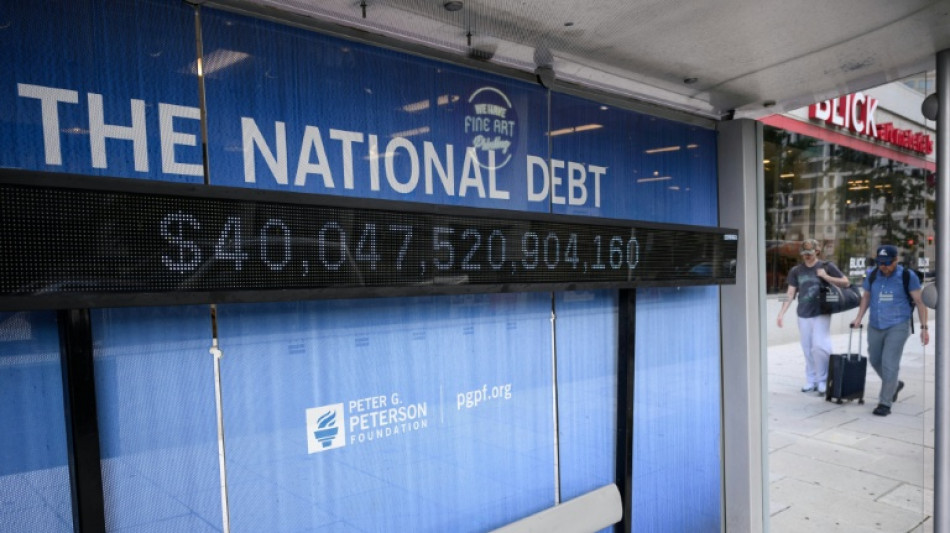
US national debt exceeds $40 trillion for first time / Photo: Mandel NGAN - AFP
The US gross national debt has surged past $40 trillion for the first time, government data showed Wednesday, outstripping earlier forecasts at a pace fuelled in part by President Donald Trump's invalidated tariffs.
The uptick in borrowing comes as longer term US obligations linked to social security and health care have been growing, while interest payments have climbed as well.
Total public debt outstanding stood at $40.05 trillion at the close of business Tuesday, according to data released Wednesday by the Treasury Department.
This stands in contrast to an earlier forecast by the Congressional Budget Office that overall borrowing would hit $39.4 trillion by the end of fiscal year 2026.
Rising US debt comes as concerns over inflation, war in the Middle East and government spending have been driving investor worries, and the cost of borrowing has grown.
Yields on long-term Treasury bonds rose Tuesday to the highest level since 2007, reflecting growing price pressures due to war on Iran and anxiety over US deficit spending.
The increase forces the US government to refinance debt at the highest rates since before the 2008 global financial crisis.
But the US Treasury Department moved to steady the long-term bond market early Wednesday, sending yields lower.
The federal government operates at a deficit and borrows money to help cover its obligations, including its war spending and tax cuts.
"It's been well known for a while that the United States government was on a pretty unsustainable path with deficits," said Jessica Riedl, a budget and tax fellow at the Brookings Institution.
"Over the last few years, the United States has moved into roughly $2 trillion deficits, even during peace and prosperity," she added.
While deficits of three percent to four percent of GDP used to worry financial markets, she noted that levels are closer to six percent to seven percent of GDP now.
"That has made markets more nervous," she said.
As inflation pushed interest rates higher, interest costs on the debt have risen as well, and costs linked to an ageing population are pushing up deficits.
- Risks ahead -
Analysts note that there is no debt-to-GDP level that automatically triggers a crisis.
Although the gross debt marks a symbolic threshold, many economists consider debt held by the public to be the most economically meaningful measure.
"But psychologically, these are the landmarks that warn financial markets that they need to take another look at rising debt," Riedl said.
Federal borrowing surged during the Great Recession of 2007-2009 and increased following the government's response to the downturn triggered by Covid-19, said Caleb Quakenbush, director of fiscal policy at the Bipartisan Policy Center.
But he told AFP that the trajectory of US budget spending has not been addressed by Congress or US administrations in a "meaningful or durable way."
He warned of uncertainty surrounding the "unprecedented levels of borrowing that we're seeing now."
Bond markets could face steep challenges in a crisis scenario, he noted.
But even outside that situation, the United States could see higher borrowing costs for consumers and businesses, squeezing the economy.
Treasury Secretary Scott Bessent had previously set a goal of cutting the US deficit to three percent of GDP.
N.Simek--TPP