Ebola vaccine trial begins in DR Congo / Photo: Saidu BAH - AFP/File
The first clinical trial of an Ebola vaccine in the outbreak gripping the Democratic Republic of Congo began Friday, the head of the World Health Organization said.
The DR Congo's worst-ever Ebola outbreak has passed the 9,700-case mark, with the number of deaths exceeding 4,600.
Among the many challenges facing the response is the lack of any approved vaccines or treatments for the Bundibugyo species of Ebola behind the epidemic.
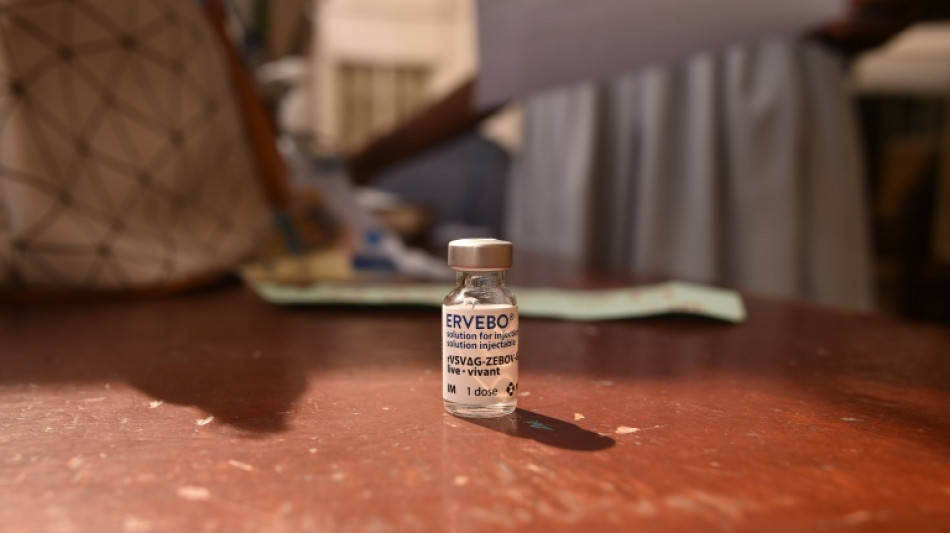
Ervebo, a vaccine approved for use against the more common Zaire strain of Ebola, will be put through a full-scale human trial in the DRC to see if it offers any cross-protection against Bundibugyo.
The trial began with the first shot of Ervebo being administered in Bunia, the capital of the DRC's northeastern Ituri province, which is the epicentre of the outbreak.
"Science gives us hope. Today, in Bunia DRC, the first participants were vaccinated in a new Ebola vaccine trial called Tumaini, which means 'hope' in Swahili," WHO chief Tedros Adhanom Ghebreyesus said on X.
"This trial will help us understand whether any of the vaccine candidates designed for Bundibugyo virus work," he said, adding that in the meantime, the existing Ervebo vaccine would be tested.
"WHO is supporting this DRC-led effort to find answers and save lives."
- Two vaccines in the pipeline -
The so-called Tumaini trial is a single trial framework that can test the safety, efficacy and immunogenicity of multiple vaccines.
The trial will use a ring vaccination approach: immunising contacts deemed to be at high risk of infection.
It is gearing up to incorporate two Bundibugyo-specific candidate vaccines, which are currently advancing through earlier-stage, smaller-scale clinical trials.
One is a ChAdOx1 adenoviral vector jab being developed by the University of Oxford; the other, by the US-based Moderna group, uses mRNA technology.
Both have received funding from the Coalition for Epidemic Preparedness Innovations, and are expected to enter the trial "shortly", CEPI said in a statement.
"Tumaini will work closely with affected communities, health authorities and outbreak response partners to generate robust evidence on vaccine performance that could contribute to curtailing the epidemic, saving lives, and strengthening preparedness for future Bundibugyo outbreaks," said CEPI.
The trial will include pregnant women and children aged 12 years and older, generating evidence for populations that are often excluded from clinical trials.
- 'Important step' -
WHO emergencies director Chikwe Ihekweazu said the trial was set up to generate the rigorous evidence needed to determine whether the participating vaccines could protect people at risk.
"If successful, this would be the first time we have clear evidence of vaccine efficacy against Bundibugyo virus -- a major advance that could transform how we respond to this outbreak and prepare for future outbreaks and help save lives," he said.
Ebola, which spreads through contact with bodily fluids and causes a haemorrhagic fever, has killed more than 15,000 people in Africa over the past 50 years.
"Bringing this trial into the Ebola response is an important step towards addressing the urgent needs of affected communities," said Steve Ahuka-Mundeke, the DRC Ebola response incident manager.
The DRC declared its 17th outbreak of Ebola on May 15, and the WHO two days later triggered a public health emergency of international concern, its second-highest alert level.
R.Rous--TPP