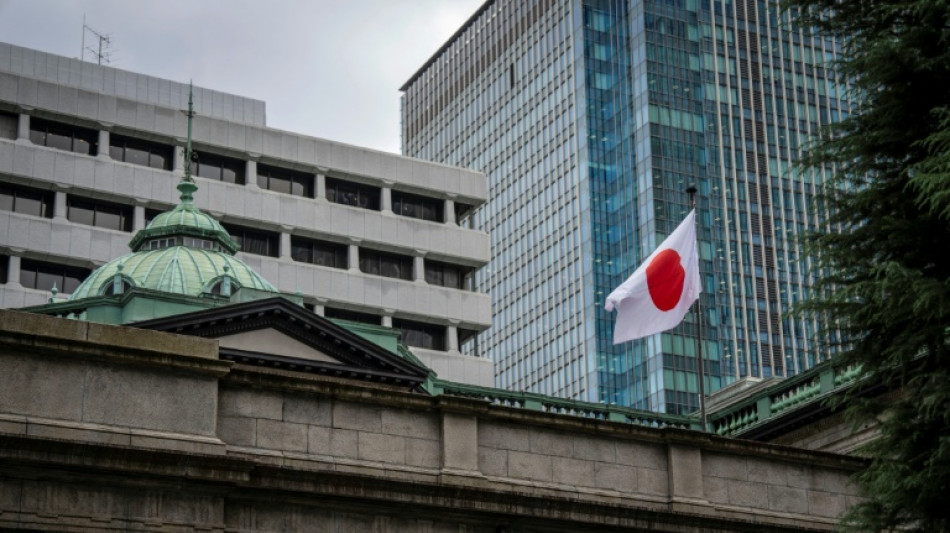
Bank of Japan set to raise rates under pressure from inflation, US / Photo: Yuichi YAMAZAKI - AFP
The Bank of Japan is poised to raise interest rates again on Friday to counter inflation fuelled by surging energy prices and to support the yen, under Washington's watchful eye.
Markets are awaiting the US Federal Reserve's decision on Wednesday, after the European Central Bank announced an increase last week.
For the BoJ, which meets Thursday and Friday, suspense is limited: some of its members have themselves sent signals suggesting they will raise its key rate by 0.25 percentage points to 1.25 percent, the highest level in more than three decades.
The last hike was in June.
Pressure has increased on officials to lift borrowing costs as a spike in oil prices caused by the Middle East crisis, which shows little sign of ending anytime soon, is expected to keep putting upward pressure on inflation.
Meanwhile, the cheap yen is also driving up the cost of imported goods.
Inflation accelerated in July towards the two percent target set by the BoJ.
"A hike to 1.25 percent at the September policy meeting has already been priced in," Takehiko Nakao, Japan’s former currency chief and former president of the Asian Development Bank, told AFP.
"In the face of advancing inflation, interest rates must be raised in a timely manner to contain it. If the response is delayed... you may end up having no choice but to raise rates sharply," he added.
This points to the prospect of further, closely spaced hikes as the war in the Middle East drags on.
"We expect inflation excluding fresh food and energy to rise further towards 2.5 percent by early next year," said Marcel Thieliant of Capital Economics.
"And if the government doesn't resume subsidies for electricity and gas, higher generation costs could lift headline inflation well above three percent," said Thieliant, who expects rates to hit two percent by mid-2027.
- Weak yen -
Central bankers are also minded to provide support to the yen, which fell in July to its weakest level against the dollar in 40 years, prompting a historic joint intervention in foreign exchange markets by the United States and Japan to provide support.
The unit had been weighed in particular by the wide gap between Japan's still low interest rates and those of the Federal Reserve, which encouraged investors to favour better-yielding dollar-denominated assets.
The "joint intervention in late July had a short-lived impact on the yen but has increased pressure on the BoJ to accelerate the pace of rate hikes", said Shigeto Nagai, an analyst at Oxford Economics.
"Financial markets appear to reflect the idea that the US Treasury secretary demands faster rate hikes in exchange for intervention," he said.
"The economic and political cost of disappointing markets and the US has become too big for the BoJ and government to ignore," he warned.
In an August conversation with BoJ Governor Kazuo Ueda, Bessent expressed "strong support for Japan's decisive market and monetary steps to address the substantial undervaluation of the yen".
After years of ultra-accommodative policy up to 2024, "the Bank of Japan's slow move toward normalising interest rates is a major factor behind the weak yen", said Nakao.
A weak yen tends to make imported goods more expensive, thus fuelling inflation. While it can strengthen the competitiveness of Japanese exporters, "the downside -- declining purchasing power weighing on consumption and investment -- is not sufficiently understood", warned Nakao.
Above all, to support the yen "it is important that the Japanese government reduce its outstanding debt and secure market confidence".
The fiscal policy of Prime Minister Sanae Takaichi, which favours a robust stimulus with higher public spending -- notably on defence and tax breaks -- is worrying investors.
The yield on Japan's 10-year government bonds climbed above three percent on Tuesday, its highest level since 1996.
Adding to market concerns was Japan's approval Tuesday of a drastic reduction in the sales tax on food, starting in April.
F.Prochazka--TPP