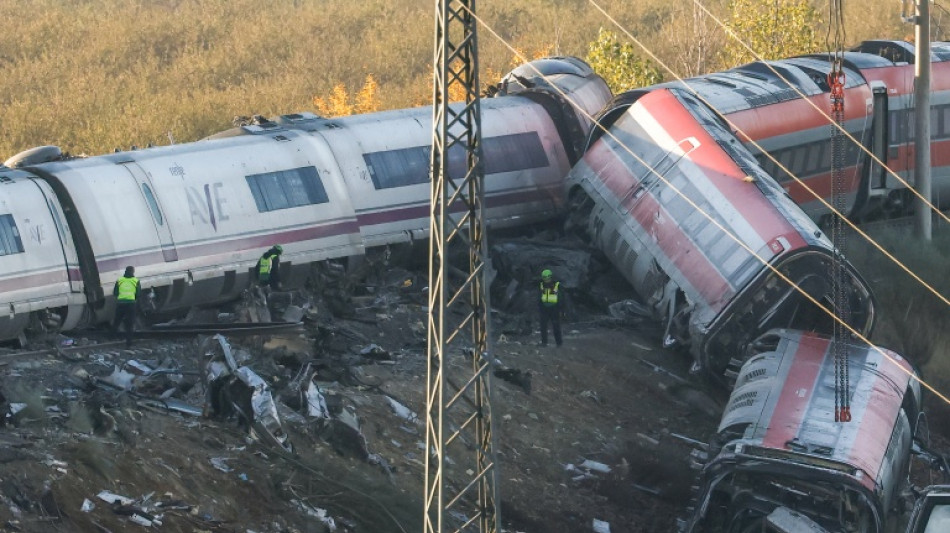
Grieving Spain demands answers for latest rail disaster / Photo: Oscar DEL POZO - AFP
Spain began demanding answers on Thursday after its second high-speed train collision this year killed 69 people and injured scores, with distraught relatives desperately seeking news about their loved ones.
One of Europe's deadliest rail disasters this century struck south of Madrid on Wednesday morning when a service by state operator Renfe ploughed into the back of a stationary train belonging to private Spanish company Iryo.
Manuel San Emeterio, whose 54-year-old brother Pepe is missing, came to the central city of Toledo to provide DNA samples to the Civil Guard.
"The uncertainty is the worst thing that you deal with, everyone is dealing with it," he said. "But I think there's something that counters it, which is hope... we must never lose it."
Toledo has received 52 of the corpses, overwhelming its morgue's capacity of 30 and forcing the army to set up an improvised facility.
Forensics experts in green jackets, a black funeral car and army vehicles moved in and out of the site, equipped with red marquees and refrigerated containers, an AFP reporter saw.
Sniffer dogs and thermal drones were searching for bodies at the crash site outside the central village of Urda, around 130 kilometres (80 miles) south of Madrid.
The toll rose from 68 to 69 on Thursday, according to regional authorities. Among the victims was Fatima Banez, a former labour minister for the main conservative Popular Party (PP).
- 'Nervous and desperate' relatives -
Jose Miguel Fernandez, a parish priest in Urda, joined the emergency services in offering support to families still waiting to learn the fate of their loved ones.
"Many of them were calm, others were nervous and desperate. They wanted to know straight away and get news" of their loved ones, he told AFP.
Flags flew at half-mast on public buildings with official ceremonies and public events cancelled or scaled back on the first of three days of national mourning.
A minute of silence was observed up and down the country, including at Spain's busiest train station Atocha in Madrid, where some mourners shed tears.
Wednesday's accident happened on a key line linking Madrid to the southern city of Seville, which was also the scene of a collision in January that killed 46 people.
It has raised fresh questions about safety on Spain's high-speed rail network, the second-largest in the world after China's.
Toledo resident Marcos Ibanez, who works in tourism, told AFP he had avoided high-speed trains "for a long time because of this".
"I've gone through the place where the accident happened several times... and you never know when it might be your turn," the 28-year-old said. "Most people are pretty fed up."
During a visit to the disaster site, Prime Minister Pedro Sanchez, who faces a general election on November 29, pledged "to establish every last detail of this tragedy and strengthen safety measures to ensure it never happens again".
King Felipe VI also intervened in the debate after visiting the injured in Toledo, calling for measures "to ensure this does not happen again".
- 'Searching for culprits' -
Transport Minister Oscar Puente said on Wednesday that an automatic control system went down on 69 kilometres of track, causing all trains there to be stopped.
But the control centre decided to "resume traffic in circumstances that, from our point of view, are inexplicable", Puente said, with the Renfe train travelling 25 kilometres before striking the Iryo.
The control centre "had more than enough time to verify the error, and they did not fix it", he added.
Sanchez's main rival, PP leader Alberto Nunez Feijoo, accused Puente of "frivolity" by trying to pin the blame on one control centre operator.
"Political responsibilities cannot wait for an investigation," Feijoo said.
The head of train driver union Semaf, Diego Martin, said "attention is wrongly being focused on searching for culprits" when workers were using "degraded systems".
Renfe train drivers on Thursday maintained a strike that Semaf had called before the accident "to defend rail safety", saying previous commitments on the issue had been broken.
The Madrid region's sprawling commuter network suffered the most disruption, with 81 percent of its planned services cancelled.
O.Holub--TPP