'We're losing our scientists': west Africa's STEM struggle / Photo: Sia KAMBOU - AFP
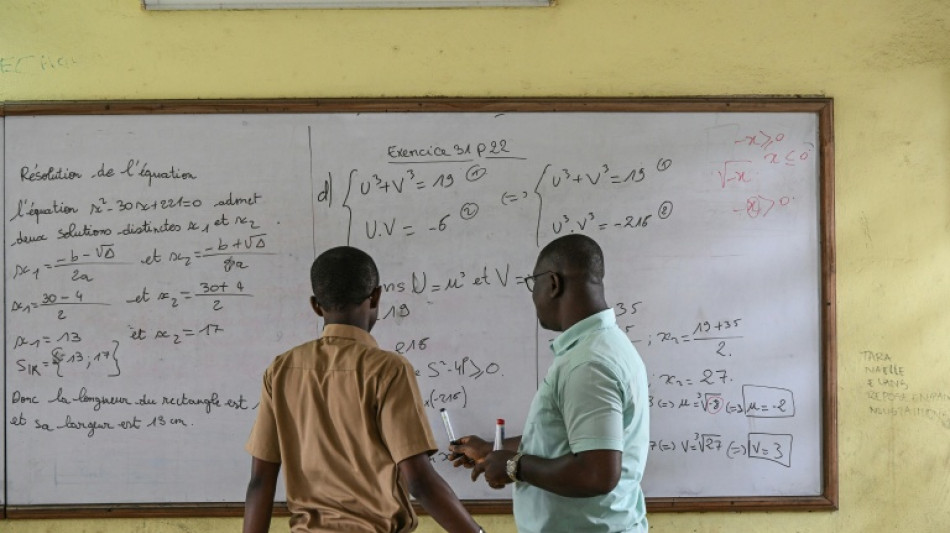
A handful of pupils puzzled over equations on the blackboard of an Abidjan maths class. Next door, the humanities classes were all packed.
This is becoming a familiar sight across west Africa, where fewer and fewer students are choosing to study science.
In Ivory Coast, just 0.6 percent of youngsters sitting the end of high school baccalaureate exam in 2022 were on the elite maths-and-physics track, according to education ministry figures.
Another 38 percent took the broader sciences stream, down from 45 percent in 2015.
But Ivory Coast is not alone. Mali, Burkina Faso, Guinea, Senegal and Niger have all seen interest in science dwindle, despite repeated government promises to produce more engineers, researchers and innovators.
In an 11th-grade science class at Abidjan's prestigious Lycee Moderne de Cocody, students packed three to a bench worked on equations as maths teacher Fabrice Guei fired questions at the room.
Boys wore khaki uniforms; the girls, white shirts and flowing navy-blue skirts. Only a few hands went up timidly.
"Not always the same ones," Guei joked.
That day, 37 students were in the room, a decent turnout by local standards but a far cry from literature classes, which can swell to 80 pupils.
Having 30 students in a maths-and-physics class is quite rare these days, said Melagne Agnimel, Ivory Coast's inspector-general for secondary education.
"In most schools, you'll find classes with seven, eight or 10 students at most," he said.
- No teachers, labs or jobs -
Officials blame years of underinvestment in science education, a lack of teachers and too few labs and equipment.
Many students also think science is just too hard.
"Students are afraid of choosing science streams because they think it means more work," Agnimel said. "So they choose humanities instead."
Guei argued that some teachers make matters worse by making maths and science seem intimidating and "scaring the children".
Others say the problem continues after graduation.
University courses often struggle to keep pace with scientific advances, engineering schools are scarce and career prospects can seem limited.
"For those lucky enough to get into certain schools or win scholarships abroad, the opportunities are there," said physics and chemistry teacher Youan Bi, dressed in a white lab coat.
"But for those who stay here, teaching is often the main option," he added, noting salaries were just not enough.
The result is a familiar headache for many African countries: a steady brain drain as scientists look for work overseas.
"We are losing our scientists," Agnimel said.
- 'A lot of sacrifice' -
The picture is similar across the region.
In Senegal, the share of students taking science streams in the baccalaureate has fallen from nearly 30 percent in the early 2000s to 15.5 percent in 2026.
In Niger, some high schools have shut science classes altogether because too few students signed up.
The decline comes as African governments push to develop sectors ranging from medicine and manufacturing to AI and new technologies.
Yet Africa accounts for only a tiny share of global scientific research, and many experts say the continent risks falling further behind without a new generation of researchers and engineers.
Governments are scrambling to reverse the trend.
Across the region, authorities have launched awareness campaigns, opened science-focused schools and expanded specialist programmes.
In Ivory Coast, officials are creating science hubs nationwide and new elite preparatory classes aimed at attracting top students in maths and physics as part of a broader effort to revive the discipline.
For some students, the challenge is worth it.
Abdoulaye Harouna, a 19-year-old final-year maths-and-physics student, admitted he spent years questioning his choice.
"It's a really difficult stream that demands a lot of sacrifice," he said with a smile.
But watching his older brother, who studied the same subjects and now works as a solar-energy engineer, helped convince him to stick with it.
"If you do well in this field," he said, "your future is guaranteed".
F.Vit--TPP