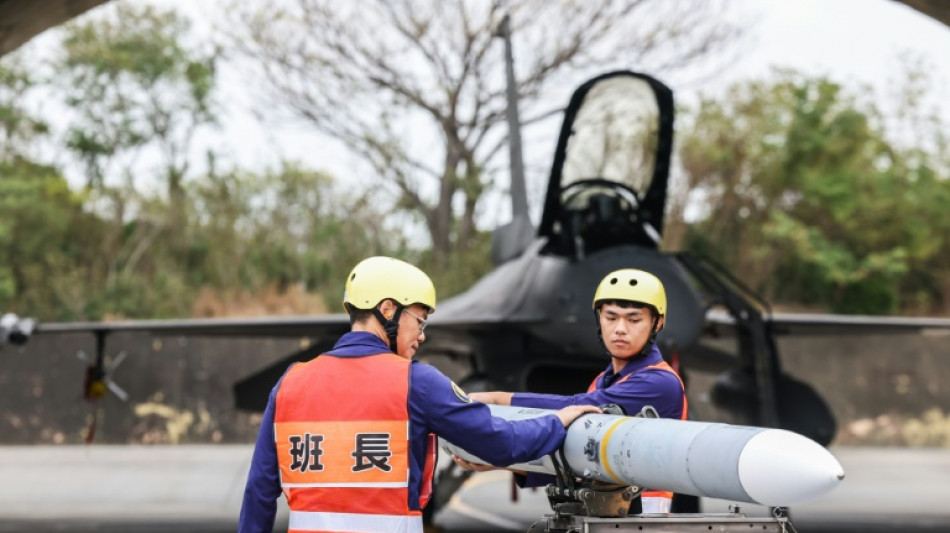
Taiwan's political standoff stalls $40 bn defence plan / Photo: I-Hwa Cheng - AFP/File
Taiwanese President Lai Ching-te's ambitious $40 billion defence spending plan is caught in a political deadlock as opposition lawmakers refuse to consider the proposal without government concessions, sparking criticism in Washington.
Taiwan has spent many billions of dollars upgrading its military in the past decade, but is under intense US pressure to do more to protect itself against the growing threat from China, which claims the island is part of its territory and has not ruled out using force to annex it.
Lai, whose Democratic Progressive Party (DPP) lost its parliamentary majority in elections that swept him to power in 2024, has vowed to increase defence spending to more than three percent of GDP this year.
But bitter divisions between the DPP and opposition parties, which hold the most seats in parliament, have culminated in the government's proposal being blocked 10 times since early December.
"We must continue to strengthen our national defence," Lai insisted Thursday, repeating calls for the opposition to review the government's $40 billion special defence budget and its 2026 general budget, which is also languishing in parliament.
Unveiled in November, the plan for extra defence spending comes as the island seeks to deter a potential Chinese invasion.
Lai said the military wanted a "high level" of joint combat readiness against China by 2027 -- which US officials have previously cited as a possible timeline for a Chinese attack on the island.
The funds would be spread over eight years and go towards paying for new arms from the United States -- including some of the $11 billion worth of purchases announced in December -- and enhancing Taiwan's ability to wage asymmetrical warfare.
Taiwan has said it wants to develop a so-called "T-Dome" -- a multi-layered air defence system -- and buy long-range precision strike missiles, counter-drone systems and anti-ballistic missiles.
The opposition parties, Kuomintang (KMT) and Taiwan People's Party (TPP), insist they support strengthening Taiwan's defences but are frustrated over ongoing delays in US deliveries, including 66 F-16V fighter jets.
They are demanding, among other things, more details from the government about the planned purchases and also want Lai to appear in parliament to take questions from lawmakers, which he has refused.
"While multi-year defence budgets may support strategic continuity, they must be accompanied by detailed planning, clear allocations, and effective oversight to prevent waste and inefficiency," said the KMT, which favours closer ties with Beijing.
- 'Rising Chinese threats' -
The TPP successfully submitted for review a stripped-down version of the defence bill on January 30 -- the day before a weeks-long parliamentary recess began -- allocating $12.6 billion for military purchases.
The KMT is drawing up its own plans to carve out up to $28.4 billion from the government's proposal and allocate that portion for US arms procurement, KMT lawmaker Huang Jen told AFP.
Lai has warned that the continued blocking of the government's plan and approval of the TPP's version will "inevitably delay the improvement of defence capabilities and may lead the international community to misunderstand Taiwan's determination to defend itself."
China has ramped up military pressure on Taiwan in recent years, deploying warships and fighter jets around the island on an almost daily basis, and has launched six rounds of large-scale drills since 2022, most recently in December.
The political impasse is already causing frustration in Washington, which has given full-throated support to Lai's defence plan and has been lobbying opposition parties to get on board.
"I'm disappointed to see Taiwan's opposition parties in parliament slash President Lai's defense budget so dramatically," Republican Senator Roger Wicker posted on social media platform X.
"The original proposal funded urgently needed weapons systems. Taiwan's parliament should reconsider -- especially with rising Chinese threats."
- 'No one wants to compromise' -
Some observers fear the budgetary standoff could continue for months, even extending beyond district elections in November, unless the KMT starts to feel domestic pressure.
"For the moment, there's impunity for the KMT in the strategy that they have been implementing in the past 18 months," a diplomat in Taipei told AFP on the condition of anonymity.
Taiwan is known for its raucous politics, but longtime watchers say they have never seen it so messy.
"It's not that William Lai doesn't want to compromise, it's that no one really wants to compromise," Lev Nachman, a political science professor at National Taiwan University, told reporters.
But Deputy Foreign Minister Chen Ming-chi said he was "cautiously optimistic" the opposition would eventually come round.
"We hope that in the new (parliamentary) session there will be more opportunity to cooperate," Chen told AFP in an interview on Thursday.
D.Dvorak--TPP