US begins 'biggest ever' Philippines war games in thick of Mideast war / Photo: Ted ALJIBE - AFP
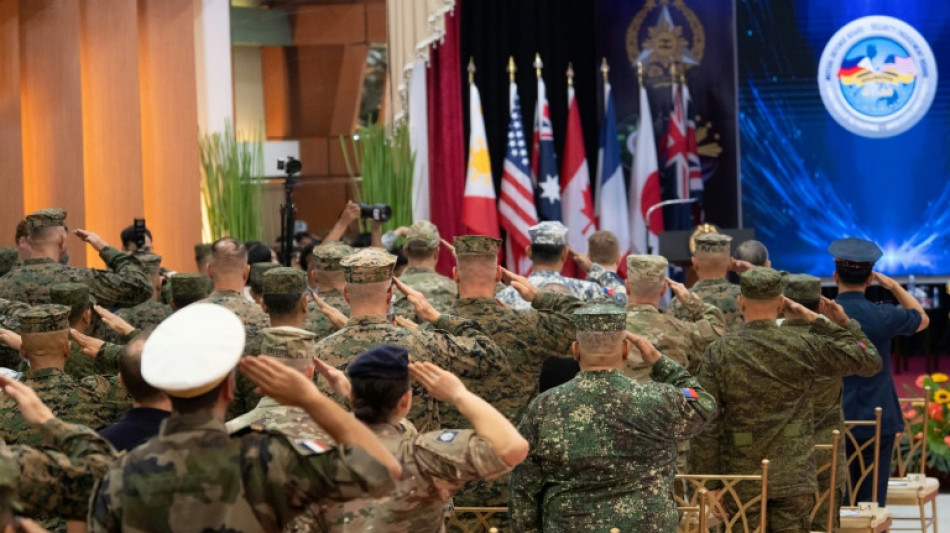
Thousands of American and Philippine troops, joined for the first time by a significant contingent of Japanese forces, began annual military exercises Monday set against the backdrop of the Middle East war.
The war games will feature live-fire exercises in the north of the country facing the Taiwan Strait, as well as a province off the disputed South China Sea, where the Philippines and China have engaged in repeated confrontations.
In one drill, the Japanese military, which is contributing about 1,400 personnel, will use a Type 88 cruise missile to sink a World War II-era minesweeper off the coast of northern Luzon island.
More than 17,000 soldiers, airmen and sailors are taking part in the 19-day Balikatan, or "Shoulder to Shoulder," exercises -- about the same number as last year's edition, including contingents from Australia, New Zealand, France and Canada.
Balikatan comes as Iran and the United States, along with Israel, edge towards the end of the two-week ceasefire that halted the Middle East war, ignited by surprise US-Israeli strikes on Iran.
"Regardless of the challenges elsewhere in the world, the United States' focus on the Indo-Pacific and our ironclad commitment to the Philippines remains unwavering," US Lieutenant General Christian Wortman said at Monday's opening ceremony.
Without providing precise numbers, Wortman, commander of the Marine Expeditionary Force, later told reporters that approximately 10,000 US personnel would take part in the exercises.
Philippine military chief General Romeo Brawner added that US Indo-Pacific Command chief Admiral Samuel Paparo had assured him at the war's outbreak that this year's Balikatan would be "the biggest ever".
"Through integrated air and missile defence, maritime security operations, live fire exercises, and joint multinational readiness training, the nations are building systems that think, move, and respond as one," Brawner said.
Among the high-end weapons expected to be involved during the annual exercise is a US Typhon missile system that has been in the archipelago since it was left by visiting US forces in 2024, provoking outrage from Beijing.
"We anticipate that it will be incorporated at some level during the course of the exercise," Wortman confirmed.
- Proximity to Taiwan -
While both militaries insisted that no exercises would take place "near Taiwan", coastal defence drills are set for the Philippines' northernmost Batanes island chain, fewer than 200 kilometres (120 miles) from the self-ruled island's southern coast.
Beijing has ramped up military pressure around Taiwan, which it considers part of its territory, and has threatened to use force to seize the self-ruled island.
Philippine President Ferdinand Marcos warned last November that given his country's proximity to the island democracy, "a war over Taiwan will drag the Philippines, kicking and screaming, into the conflict."
In February, US, Japanese and Philippine aircraft patrolled over the Bashi Channel that separates the Philippines from Taiwan to test what Manila called their "ability to operate seamlessly together in complex maritime environments."
Japan's first Balikatan as a full participant follows the signing of a reciprocal access agreement that was approved by the Japanese Diet in June last year.
Speaking on the sidelines to Japanese media, Colonel Takeshi Higuchi of Tokyo's joint staff said the drills would "contribute to creating a security environment that tolerates no attempt to unilaterally change the status quo by force".
Marcos has been building up security ties with Western nations to deter China. Over the past two years, Manila has also signed visiting forces or equivalent agreements with New Zealand, Canada and France to facilitate their participation in joint military exercises.
Outside the Manila base where Monday's opening ceremony was held, a group of about 50 people protested against the exercises, holding aloft signs branding US President Donald Trump an "imperialist terrorist" and demanding US forces leave the country.
V.Nemec--TPP