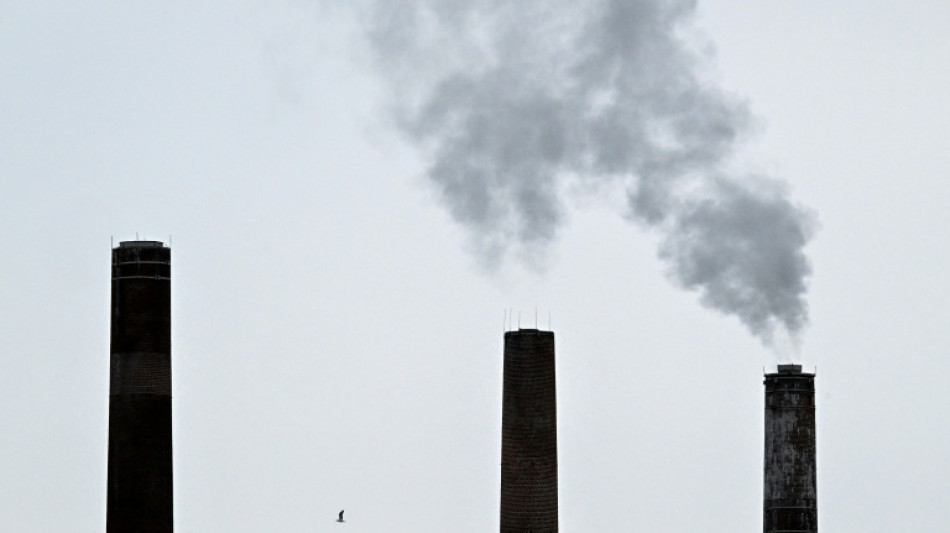
EU reforms carbon market under pressure from industry / Photo: Kirill KUDRYAVTSEV - AFP/File
The European Union on Friday proposed easing its carbon trading scheme for companies, as it unveiled reforms to one of its flagship climate policies under pressure to shore up industry.
The overhaul of the two-decade-old Emissions Trading System (ETS) has been subject to fierce wrangling between countries, industry and activists over the pace of the bloc's climate push.
In the face of demands from carbon-intensive economies such as Italy and Poland, Brussels has laid out a series of concessions that will now need to be agreed with all 27 member states and EU lawmakers.
Broadly speaking, the reforms would allow European industry in the coming years to carry on carbon emissions for a longer period and at a lower cost than previously set.
If they commit to investing in decarbonisation efforts, companies will still be able to obtain free carbon allowances until 2038, instead of 2034 as was previously the case.
"We are adopting a more business-friendly and, may I say so, savvy approach," said EU climate commissioner Wopke Hoekstra, while insisting the bloc was still sticking to its overall ambitions.
Starting in 2036, manufacturers will also be able to purchase international carbon credits by financing decarbonisation projects outside the EU, which would count toward their emissions reductions.
Since 2005, the EU's carbon trading system has sought to tackle climate change by curbing pollution from power producers and energy-intensive industries such as steel, cement and chemicals.
The ETS forces heavy polluters to pay for the greenhouse gases they emit, obliging them to buy allowances that are capped in number, sold in auctions and tradable.
The scheme was already scheduled for review, but the July overhaul pitched countries such as Italy, Poland and Czech Republic wanting it watered down against the system's defenders including Spain and the Scandinavian nations.
In the face of the spike in energy prices caused by the US-Iran war and the record heatwaves in Europe, advocates have been pushing for the EU to stick to its ambitious climate goals.
But, caught between the United States and China, momentum has shifted to a more pro-business stance since the start of European Commission chief Ursula von der Leyen's second mandate in 2024 -- prompting a rollback of environmental rules that marked her first term.
In a bid to show its climate ambitions remain intact, the EU separately laid out an ambitious target to boost the use of clean electricity from renewable sources as opposed to fossil fuels by 2040.
Brussels wants to hit 46 percent of final energy consumption in the bloc, double the level being achieved today.
- Flights and waste -
While Brussels may be easing some of the demands on industry under the carbon trading scheme, it is also pushing countries to channel revenues from the ETS into decarbonising industry -- an area where performance varies widely.
Two sensitive issues were also whether to include flights outside Europe and the waste sector in the scheme.
In the face of strong pressure from airlines and reluctance from some countries including France, the European Commission is proposing a staggered approach to flights beyond Europe.
Under the plan flights outside Europe would be covered by the ETS if they are less than 5,000 kilometres.
For example, a flight from Frankfurt to Dubai or Istanbul would be covered by the ETS, but Frankfurt to Tokyo would not.
All flights by private jet would now also fall under the scheme.
Meanwhile, Brussels wants to "gradually" integrate the waste sector into its carbon market.
Member states may be granted an exemption until 2035 if they meet recycling targets or already have an equivalent national tax in place.
One collateral victim in the reforms appears likely to be "ETS 2" -- the planned extension of carbon pricing to road transport and building heating, which has already been pushed back from 2027 to 2028 at the request of countries including Poland and Hungary.
D.Kovar--TPP