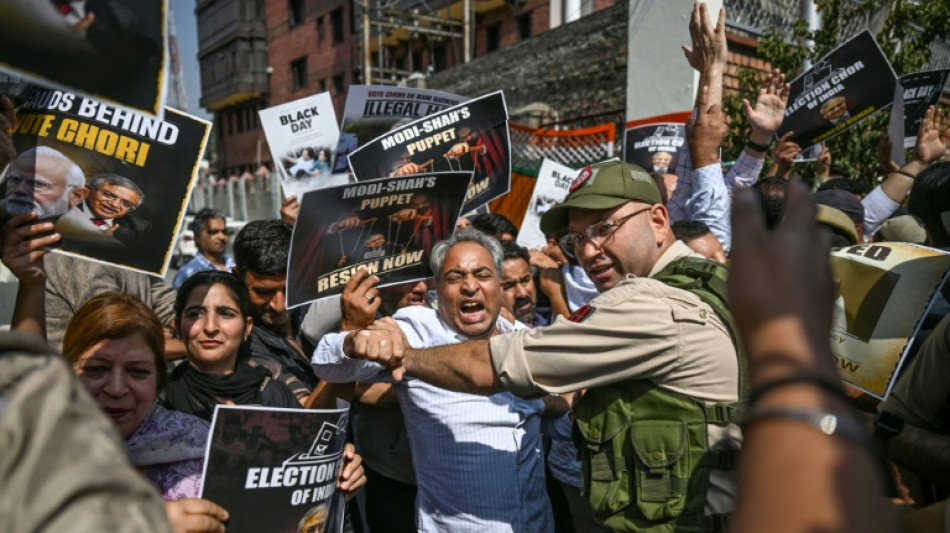
The 'cockroach' protests against India's election body / Photo: Tauseef MUSTAFA - AFP
India's viral Cockroach Janta Party (CJP) movement has returned to the streets of New Delhi, leading protests over alleged misconduct by the country's election commission during a nationwide voter-roll revision.
The demonstrations mark the latest challenge to Prime Minister Narendra Modi's government, months after student-led protests spearheaded by the group forced the resignation of the education minister.
AFP looks at the key developments here:
- Who are the 'cockroaches'? -
The CJP was launched in May by Abhijeet Dipke as a satirical online movement after India's chief justice reportedly likened young people who criticised the government to "cockroaches" and "parasites".
The group's Instagram following has since swelled to more than 25 million, surpassing the roughly 10 million followers of Modi's Bharatiya Janata Party (BJP) on the platform.
Dipke told AFP that the movement drew support largely from Gen Z students frustrated by a political establishment they felt ignored their concerns.
Protests organised by the CJP spread beyond Delhi in July, evolving from anger over alleged exam irregularities into a broader campaign over unemployment and what critics describe as Modi's increasingly authoritarian rule.
The initial unrest culminated in the resignation of education minister Dharmendra Pradhan.
- What is the CJP demanding now? -
Opposition parties and critics have long alleged that legitimate voters are being struck off voter lists in India, the world's largest democracy with 1.4 billion people.
But the issue flared up last month after the Indian Express newspaper reported that key decisions linked to a voter-roll revision, which removed millions of names from draft electoral lists, may have been taken without the approval of two of India's three election commissioners.
The Election Commission of India (ECI) has rejected the allegations.
The CJP and opposition parties, however, accuse the ECI of removing legitimate voters in a way that could benefit Modi's ruling Hindu nationalist party.
Protesters, including those from opposition parties, are demanding the resignation of Chief Election Commissioner Gyanesh Kumar.
The CJP is also calling for a temporary suspension of upcoming state elections and changes to the law governing the appointment of election commissioners.
- How has the government responded? -
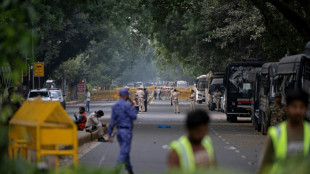
Authorities imposed a major security lockdown across parts of the capital on Friday, deploying tens of thousands of police and paramilitary personnel to prevent demonstrators from reaching the main protest site near Jantar Mantar.
Police detained Dipke and two associates on Saturday ahead of the demonstration. They were released on Sunday.
The ruling party has branded the CJP and the opposition Congress-led alliance as "anarchist groups", accusing them of creating a "dangerous" situation in the country.
- What happens next? -
The group has described its demands as "non-negotiable" and vowed to continue its campaign until they are met.
After the detention of Dipke and two other senior leaders at a Delhi airport on Saturday, the CJP appointed another member to lead the protests.
The group has asked people to "march towards" Jantar Mantar again on Sunday.
Political commentator and Modi biographer Nilanjan Mukhopadhyay told AFP the controversy over the election commission showed public anger had broadened beyond student issues.
"It has become much more widespread politically," he said.
J.Marek--TPP