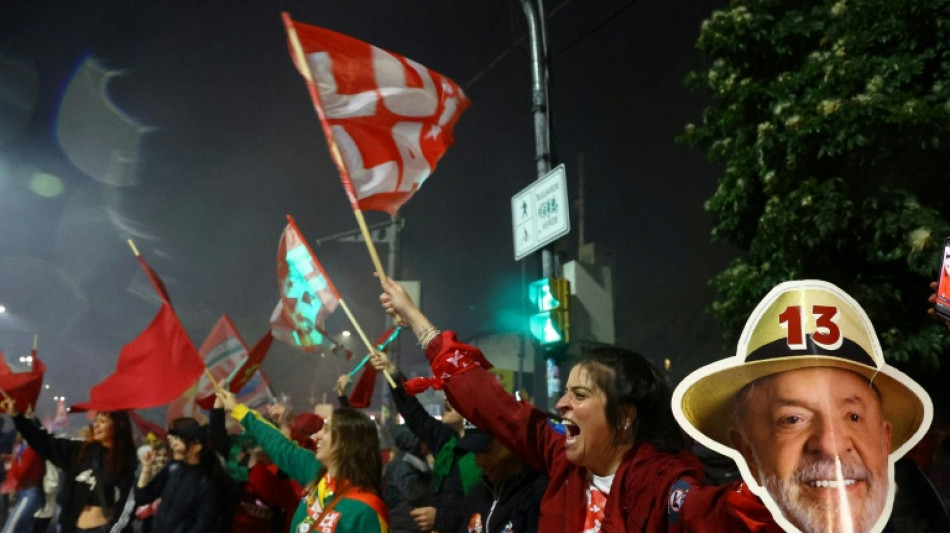
What challenges await Brazil's Lula in his fourth term? / Photo: SILVIO AVILA - AFP
President Luiz Inacio Lula da Silva will have to wrestle with a divided Brazil, an unfriendly Congress, feeble public finances and a Donald Trump-shaped menace during his unprecedented fourth term.
Days before his 81st birthday, the former union leader won Sunday's runoff with 51.7 percent of the vote over 48.2 percent for his right-wing challenger Flavio Bolsonaro.
The narrow result confirms the political divide that has split Brazil for a decade and shows that Bolsonarism remains strong, despite its far-right leader's 27-year prison sentence for attempting a coup.
Here are the main challenges awaiting Lula in his next mandate.
- Governability -
As in his current term, Lula will not have a majority in Congress.
Legislative elections earlier this month bolstered the right, making Bolsonaro's Liberal Party the leading force with 121 out of 513 deputies and 28 out of 81 senators.
To get his proposals through, Lula will depend heavily on the so‑called "Centrao," a bloc of center-right parties that usually backs whoever is in power in exchange for benefits.
But negotiating with them is becoming increasingly difficult, according to political scientist Mayra Goulart of the Federal University of Rio de Janeiro.
Lawmakers now decide the fate of an ever larger share of the federal budget, she told AFP, giving them "more independence from the executive."
- Money -
Economically, "Brazil's three big problems are the fiscal problem, the fiscal problem, and the fiscal problem," economist Mauro Rochlin of the Getulio Vargas Foundation (FGV) told AFP.
The state spends more than it collects, public debt exceeds 80 percent of GDP, and Brazil's central bank maintains one of the world's highest interest rates to contain inflation.
The situation "could very quickly turn into an economic crisis," said Rochlin.
Adjustment is inevitable but difficult since it involves "unpopular measures" and confronting "very powerful lobbies within Congress," he said.
The challenge is likely going to clash with Lula's flagship welfare programs, which have lifted millions out of poverty, and which he expanded during the campaign to win voters -- drawing fierce criticism from the opposition.
- Insecurity -
The election campaign was dominated by security concerns, with violence a huge worry for many Brazilians.
Accused by the opposition of having a soft touch, Lula will be under pressure to show results, particularly by tackling criminal groups and militias that control territory in several cities.
On the campaign trail, he said he would support lowering the age of criminal responsibility from 18 to 16 for heinous crimes, while the political right wants to reduce it to 14 years.
- Trump -
Lula campaigned on a pledge to protect Brazilian sovereignty as concerns grow about the broadening interventions of the United States across Latin America.
Trump slapped tariffs on Brazil last year in retaliation for legal proceedings against his ally Jair Bolsonaro, followed by another 25 percent tariff on some products this year.
Brazil's president will have to manage relations with Washington without relaxing his anti-imperialist tone, all while the Trump administration increasingly asserts itself in the region.
Right-wing leaders across Latin America have meanwhile aligned with Trump in a trend dubbed the "Orange Wave," in reference to the US leader's complexion.
Although ideology "matters for symbolic encounters," it is "not that relevant" in practice, according to Oliver Stuenkel, an international relations professor at the FGV.
He points to Brazil-Argentina relations as an example.
"Deep down, the substance of the relationship hasn't changed that much" despite Argentine leader Javier Milei's insults toward Lula, Stuenkel told AFP.
Y.Blaha--TPP