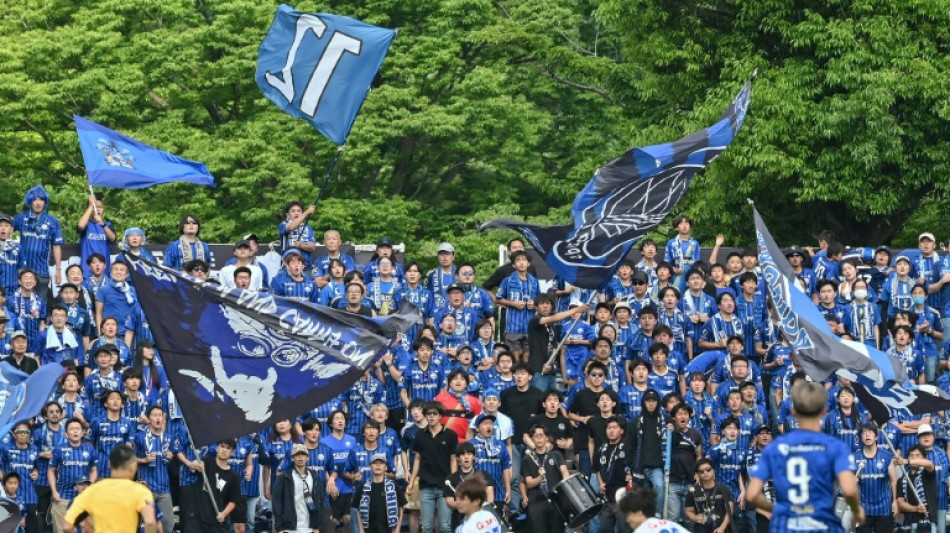
Japanese team with school coach to cap remarkable journey to the top / Photo: Richard A. Brooks - AFP
Japan's Machida Zelvia shared their clubhouse with senior citizens doing fitness classes less than a decade ago. Now they're one win away from being Asian champions.
The team from the Tokyo suburbs will look to complete their remarkable transformation from non-league nobodies to continental conquerors when they face Saudi Arabia's defending champions Al Ahli in the Asian Champions League final on Saturday in Jeddah.
Machida are making their debut in Asia's top club competition and were playing non-league football as recently as 2013.
They are led by a former high-school coach and play at a homely tree-lined stadium in front of an average 14,000 fans.
They have already beaten big-spending Saudis Al Ittihad and now have the Champions League trophy in their sights.
"I think it just shows that Machida have been doing things properly, building up step by step," journalist Kazuto Oshima, who has been covering the team since 2012, told AFP.
"It's also significant that they've shown they can play on equal terms not only in the J. League but also against clubs from Saudi Arabia and the UAE."
Machida had never played in Japan's top flight until 2024 but they almost won the title at the first time of asking and they claimed their maiden trophy last season with the domestic Emperor's Cup.
Their rapid rise has been overseen by Go Kuroda, a former high-school coach who took charge ahead of the 2023 season.
The 55-year-old took the team back to basics, prioritising a solid defence and a direct attack.
That approach has paid off in the Champions League, with Machida reaching the final on the back of three straight 1-0 wins.
Kuroda is known for his no-nonsense style and he was given a warning by the J. League at the start of this year for directing abusive language towards his staff.
Winger Yuki Soma praised the coach's man-management after scoring the winner in their semi-final victory over UAE side Shabab Al Ahli.
"The coach told me before training yesterday that I was the team's main man so I had to play well, and that really showed he trusted me," said Japan international Soma.
"I wanted to give everything to live up to that for the team, and I'm glad I was able to score."
- Legal action -
Machida's meteoric rise has not been viewed as a fairytale by everyone in Japanese football.
In 2024 the club took the unusual step of pursuing legal action against what they considered to be slanderous online abuse against staff and players, claiming they were receiving more than 1,000 abusive posts a day.
Machida's style of play has also come in for criticism, with neutrals arguing that they play route-one football and rely on long throws into the box.
Journalist Oshima says such criticism is outdated.
"They don't play the same kind of kick-and-run, high school-style football they played three years ago in the second division," he said.
"In the Champions League, where they face strong opposition, they inevitably spend more time defending but they can actually keep the ball as well.
"They're not a team that just lumps it forward and relies on workrate," he added.
Japan's professional J. League began in 1993 and most of the original clubs started life as the sporting arm of giant corporations like Toyota and Nissan.
Machida, on the other hand, were founded in 1989 as a club to represent the best local players in the area.
Six Japanese clubs have been crowned Asian champions and Oshima thinks Machida's humble origins would add extra significance if they make it seven in Jeddah on Saturday.
"More and more clubs want to join the J. League and it's a tough path, but for teams currently in non-league football, Machida have shown that if you keep working steadily, this kind of path exists," he said.
"I think it gives huge encouragement to other clubs."
V.Nemec--TPP