Bone collectors: searching for WWII remains in Okinawa / Photo: Philip FONG - AFP
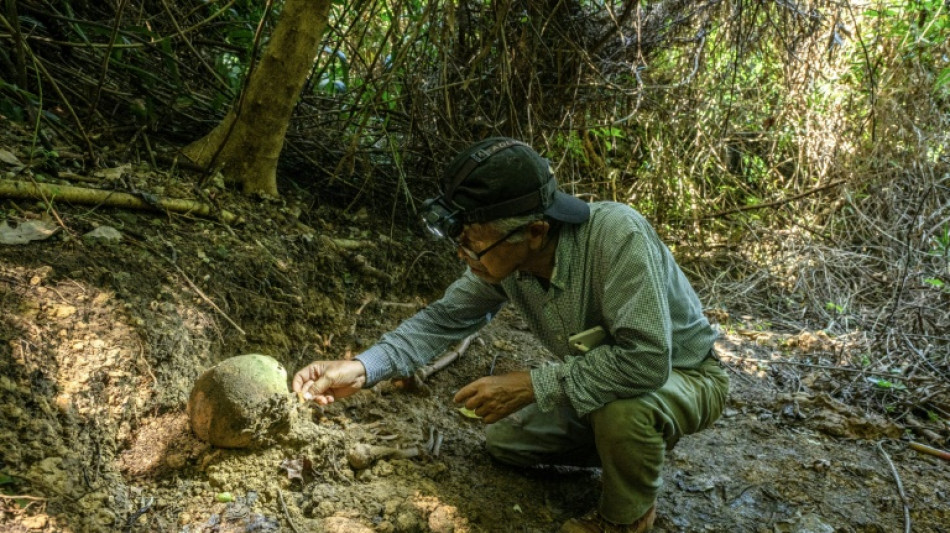
Trekking through mud and rocks in Japan's humid Okinawan jungle, Takamatsu Gushiken reached a slope of ground where human remains have lain forgotten since World War II.
The 72-year-old said a brief prayer and lifted a makeshift protective covering, exposing half-buried bones believed to be those of a young Japanese soldier.
"These remains have the right to be returned to their families," said Gushiken, a businessman who has voluntarily searched for the war dead for more than four decades.
The sun-kissed island in southern Japan on Monday marks the 80th anniversary of the Battle of Okinawa.
The three-month carnage, often dubbed the "Typhoon of Steel", killed about 200,000 people, almost half of them local civilians.
Since then, Japan and the United States have become allies, and, according to official estimates, only 2,600 bodies are yet to be recovered.
But residents and long-time volunteers like Gushiken say many more are buried under buildings or farm fields, or hidden in jungles and caves.
Now rocks and soil from southern parts of Okinawa Island, where the bloodiest fighting took place, are being quarried in order to build the foundations for a new US air base.
The plan has sparked anger among Gushiken and others, who say it will disturb the remains of World War II casualties, likely killed by Americans.
And while Okinawa is a popular beach getaway these days, its lush jungles have preserved the scars of combat from March to June 1945, when the US military stormed ashore to advance its final assaults on Imperial Japan.
- Full skeleton -
Walking through meandering forest trails in Itoman district, on the southern end of Okinawa, Gushiken imagined where he would have hidden as a local or a soldier under attack, or where he may have searched if he were an American soldier.
After climbing over moss-covered rocks on a narrow, leafy trail, Gushiken reached a low-lying crevice between bus-size boulders, only big enough to shelter two or three people.
He carefully shifted through the soil strewn with fragmented bones, shirt buttons used by Japanese soldiers, a rusty lid for canned food, and a metal fitting for a gas mask.
At another spot nearby, he and an associate in April found a full skeleton of a possible soldier who appeared to have suffered a blast wound to his face.
And only a few steps from there, green-coloured thigh and shin bones of another person laid among the dried leaves, fallen branches and vines.
"All these people here... their final words were 'mom, mom'," Gushiken said, arguing that society has a responsibility to bring the remains to family tombs.
Gushiken was a 28-year-old scout leader when he was first asked to help search for the war dead, and was shocked to realise there were so many people's remains, in such a vast area.
He didn't think he could bring himself to do it again, but over time he decided he should do his part to reunite family members in death.
- 'Every last one' -
After the war ended, survivors in Okinawa who had been held captive by US forces returned to their wrecked hometowns.
As they desperately tried to restart their lives, the survivors collected dead bodies in mass graves, or buried them individually with no record of their identity.
"They saw their communities completely burned. People couldn't tell where their houses were. Bodies dangled from tree branches," said Mitsuru Matsukawa, 72, from a foundation that helps manage Okinawa Peace Memorial Park. The site includes a national collective cemetery for war dead.
Some young people have joined the efforts to recover remains, like Wataru Ishiyama, a university student in Kyoto who travels often to Okinawa.
The 22-year-old history major is a member of Japan Youth Memorial Association, a group focused on recovering Japanese war remains at home and abroad.
"These people have been waiting in such dark and remote areas for so many decades, so I want to return them to their families -- every last one," he said.
Ishiyama's volunteering has inspired an interest in modern Japan's "national defence and security issues", he said, adding that he was considering a military-related career.
The new US air base is being built on partly reclaimed land in Okinawa's north, while its construction material is being excavated in the south.
"It is a sacrilege to the war dead to dump the land that has absorbed their blood into the sea to build a new military base," Gushiken said.
Jungle areas that may contain World War II remains should be preserved for their historic significance and serve as peace memorials to remind the world of the atrocity of war, he told AFP.
"We are now in a generation when fewer and fewer people can recall the Battle of Okinawa," Gushiken added.
"Now, only bones, the fields and various discovered items will remain to carry on the memories."
F.Vit--TPP