The Prague Post - Archaelogical 'breakthrough' could confirm origins of Paris

EUR -
AED 4.185806
AFN 72.37895
ALL 91.363279
AMD 414.238317
ANG 2.040605
AOA 1045.169442
ARS 1728.150807
AUD 1.618279
AWG 2.053011
AZN 1.934023
BAM 1.952383
BBD 2.295293
BDT 140.114765
BGN 1.918736
BHD 0.42965
BIF 3424.536276
BMD 1.13977
BND 1.456164
BOB 12.38606
BRL 5.862063
BSD 1.13961
BTN 109.051091
BWP 15.495723
BYN 3.450576
BYR 22339.494464
BZD 2.291999
CAD 1.607104
CDF 2634.009282
CHF 0.939644
CLF 0.027616
CLP 1090.440558
CNY 7.636237
CNH 7.65081
COP 3702.155732
CRC 517.097223
CUC 1.13977
CUP 30.203908
CVE 110.072829
CZK 24.412779
DJF 202.936592
DKK 7.476049
DOP 67.791349
DZD 152.571456
EGP 58.599549
ERN 17.096552
ETB 186.146914
FJD 2.549891
FKP 0.85543
GBP 0.859495
GEL 2.957738
GGP 0.85543
GHS 13.202009
GIP 0.85543
GMD 83.803565
GNF 10022.502156
GTQ 8.698851
GYD 238.424791
HKD 8.940021
HNL 30.588463
HRK 7.530804
HTG 148.949303
HUF 365.214829
IDR 20372.251227
ILS 3.457982
IMP 0.85543
INR 109.191061
IQD 1492.887085
IRR 1566785.002858
ISK 138.003476
JEP 0.85543
JMD 179.557307
JOD 0.808126
JPY 180.371468
KES 147.497261
KGS 99.672672
KHR 4621.566477
KMF 490.101219
KPW 1025.793475
KRW 1557.154117
KWD 0.352406
KYD 0.949667
KZT 506.765261
LAK 25535.418841
LBP 102052.578603
LKR 374.933775
LRD 196.571293
LSL 18.590126
LTL 3.365445
LVL 0.689435
LYD 7.275298
MAD 10.909002
MDL 20.169195
MGA 5007.258049
MKD 61.412513
MMK 2393.035557
MNT 4100.80579
MOP 9.206001
MRU 45.630536
MUR 54.572336
MVR 17.62107
MWK 1976.058755
MXN 19.918144
MYR 4.649694
MZN 72.833868
NAD 18.589963
NGN 1509.226833
NIO 41.936601
NOK 10.815672
NPR 174.481381
NZD 2.008281
OMR 0.438254
PAB 1.13961
PEN 3.847266
PGK 5.077158
PHP 71.495526
PKR 315.81315
PLN 4.378626
PYG 6754.178549
QAR 4.154665
RON 5.276113
RSD 117.529689
RUB 96.427137
RWF 1681.930781
SAR 4.281852
SBD 9.14781
SCR 15.764401
SDG 685.573659
SEK 11.28916
SGD 1.458633
SHP 0.852069
SLE 28.09485
SLL 23900.400397
SOS 651.262989
SRD 43.108956
STD 23590.940415
STN 24.457301
SVC 9.971591
SYP 14819.291464
SZL 18.585634
THB 38.064335
TJS 10.547132
TMT 3.989195
TND 3.366208
TOP 2.744293
TRY 55.663862
TTD 7.745478
TWD 36.211597
TZS 3020.388565
UAH 51.151022
UGX 4433.260167
USD 1.13977
UYU 45.680449
UZS 13447.581454
VES 970.333376
VND 29645.990855
VUV 134.889945
WST 3.137248
XAF 655.957
XAG 0.017599
XAU 0.000266
XCD 3.080286
XCG 2.053814
XDR 0.805877
XOF 655.957
XPF 119.331742
YER 269.612423
ZAR 18.658225
ZMK 10259.298615
ZMW 22.194349
ZWL 367.005515
SSP 6511.039995
MXV 2.257447
  • CMSC

    -0.1400

    20.47

    -0.68%

  • CMSD

    -0.2220

    20.198

    -1.1%

  • AZN

    -4.5900

    163.78

    -2.8%

  • RIO

    -2.3150

    95.175

    -2.43%

  • NGG

    -1.4400

    75.42

    -1.91%

  • BTI

    -0.1200

    55.63

    -0.22%

  • GSK

    -0.9400

    49.78

    -1.89%

  • RYCEF

    0.1200

    20

    +0.6%

  • BCE

    -0.1250

    21.575

    -0.58%

  • RBGPF

    -2.5300

    64.47

    -3.92%

  • BCC

    -0.1850

    78.815

    -0.23%

  • BP

    1.1600

    44.26

    +2.62%

  • RELX

    0.3350

    33.315

    +1.01%

  • JRI

    -0.1900

    11.295

    -1.68%

  • VOD

    -0.2250

    16.395

    -1.37%

Archaelogical 'breakthrough' could confirm origins of Paris
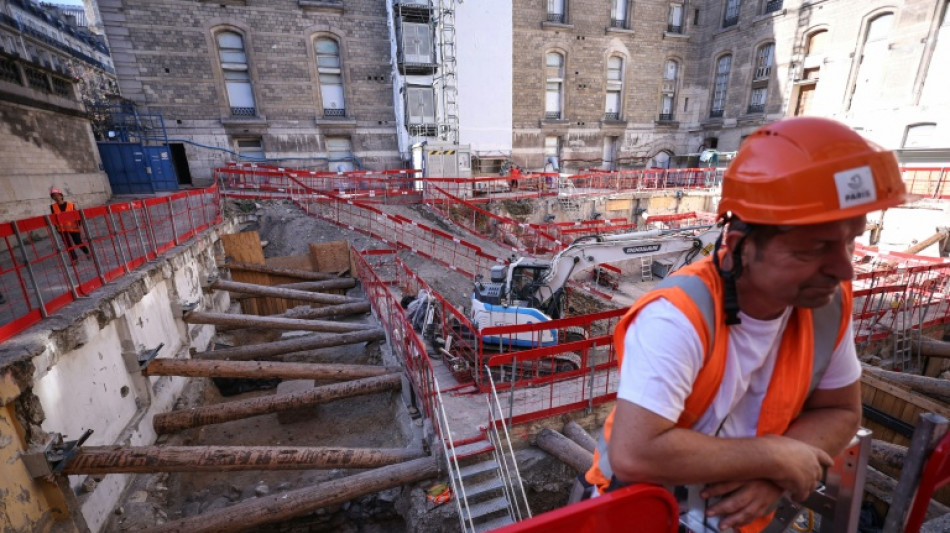
Archaelogical 'breakthrough' could confirm origins of Paris / Photo: SIMON WOHLFAHRT - AFP

Archaelogical 'breakthrough' could confirm origins of Paris

An ancient wall discovered in central Paris was hailed as a "major breakthrough" on Wednesday, as the archaeological find may have settled a long-standing debate about the location of the city's original settlement.

Text size:

A roughly 20-metre (65-foot) wall dating from the Gallo-Roman period was discovered in Paris this summer beneath a hospital on the Ile de la Cite, a stone's throw from Notre Dame Cathedral, the French culture ministry said.

The stone-and-wood find is thought to be a fragment of the ramparts of Lutetia -- the ancient name for Paris -- built by the Gallic Parisii tribe which lived along the river Seine in the Iron Age.

The Ile de la Cite has traditionally been regarded as the centre of Lutetia, but a rival theory, backed by archaeological research, contends that it was actually in Nanterre, a suburb to the west.

"We may be looking at one of the most important remains ever discovered for understanding Gallic Lutetia," Culture Minister Catherine Pegard said in a statement, which described the discovery as "a major breakthrough".

"Scientific caution still requires that we verify its function and its chronology, but the convergence of evidence is particularly remarkable at this stage."

Lutetia was first mentioned in book seven of Roman leader Julius Caesar's "Gallic Wars" series, where it was said to be on an island in the river Seine linked by bridges -- a vague description that has given rise to many theories about its location.

- 'Dizzying' -

The wall, uncovered in the course of excavations beneath the Hotel-Dieu hospital, also bears traces of fire, which may correspond to Caesar's account that the Gauls set fire to their town before the Battle of Lutetia against the Romans.

Through carbon dating technology, the charred evidence is estimated to date from 10-200 BC, the ministry said in its statement -- a timeframe that includes the Battle of Lutetia in 52 BC.

The Ile de la Cite, home to Notre Dame cathedral, is the largest island in the river Seine in the Paris region and became the centre of the Roman settlement of Lutetia.

"It's dizzying to find oneself here and to discover what is probably the origin of the city of Paris," Paris mayor, Emmanuel Grégoire, said on Wednesday after examining the wall.

It is barely a metre high and had been been buried four meters deep in a courtyard of the Hôtel-Dieu hospital, which is the oldest of the capital.

An archaeological dig began there in February.

"All of our predecessors dreamed of finding traces of Gallic presences on the Ile de la Cite," said Dorothee Chaoui-Derieux, coordinator of archaeological operations in Paris for the culture ministry.

"There has been a lot of speculation on the subject. We're fortunate to be in the right place at the right time," she added.

"Beneath our feet, thanks to the trowels of our colleagues, this wall built in the Gallic tradition is gradually revealing its secrets."

M.Jelinek--TPP