Germany's energy-hungry small firms struggle with green shift / Photo: SASCHA SCHUERMANN - AFP
Small companies that form the backbone of the German economy are struggling with the shift to carbon-neutral production, which adds extra costs when they are already battling high power prices and a broader slowdown.
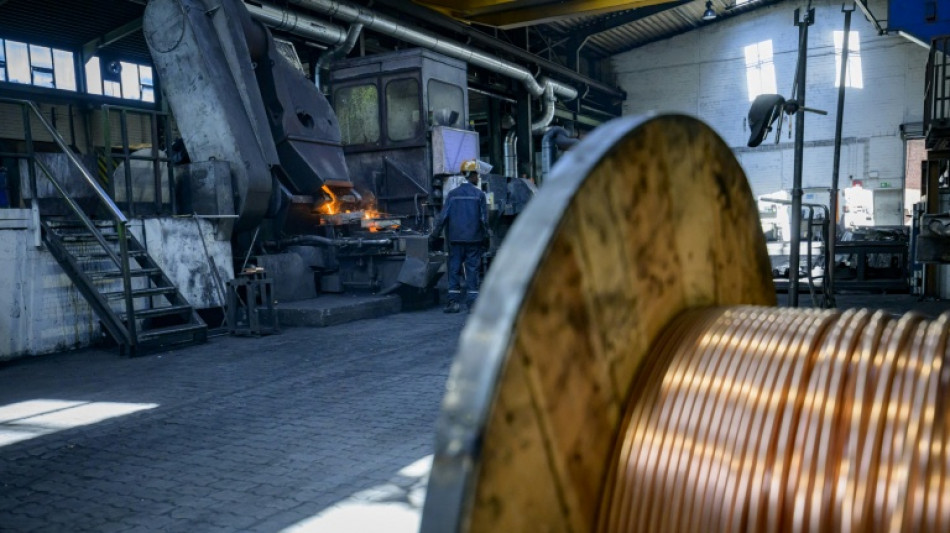
MPG Tubes -- fairly typical among "Mittelstand" small- and medium-sized businesses in Europe's top economy -- faces a huge challenge to heat metal to 1,500C without producing any of the key greenhouse gas carbon dioxide.
Its foundry is partially electrified but still uses two gas-fired furnaces to reach the temperatures needed to create tubes with a perfectly smooth finish, used in areas including construction of power plants, the automotive industry and shipbuilding.
"The major task ahead of us is to electrify all natural gas applications," Andreas Gahl, head of the firm with 145 employees in the western Sauerland region, told AFP.
This, he stressed, is "a completely different challenge from implementing simple energy efficiency measures".
His goal is to make climate-neutral products within four years, but only provided the firm remains profitable.
A major challenge is electricity prices, which are significantly higher than in other big economies like China or India, a regular gripe of Germany's vast industrial sector.
Using natural gas exclusively to make tubes would cost MPG just seven cents per kilowatt, compared with about 20 cents for electricity.
And to fully electrify the site will require around six million euros in investment for a company with a turnover of about 40 million euros -- which means taking on debt.
"The transition replaces variable costs with fixed costs: if a crisis hits and I have fewer orders, the loan burden remains," Gahl said.
The requirement for extra investments comes at a time many traditional industries in Germany are struggling, with weak demand at home and growing competition in key export markets.
- Weak grids -
Despite his worries, Gahl says he is determined to decarbonise his business due to his personal conviction when it comes to fighting the climate crisis, and believes ultimately the shift can happen "without major economic losses".
For other companies, the obstacle is not just financial, but also technical -- access to electricity.
In the northwest of the country, the LEDA foundry cannot electrify its processes due to insufficient power capacity.
Manager Fynn-Willem Lohe told AFP that his site's power is supplied by grids that are sometimes "80 or 100 years old", another major weak point in the German economy.
The company needs seven megawatts for the energy transition but currently has only two.
"We're told we'll get a connection in two or three years, but in reality it will probably be six or seven," he said.
This represents a major stumbling block for foundries hoping to decarbonise, as at least 90 percent will not get sufficient power supply before the mid-2030s, said Martin Theuringer, director of the German Foundry Industry Federation (BDG).
Lohe also fears that the transition will push up operating costs, putting extra pressure on the already struggling company.
- 'Investing in uncertainty' -
Germany's foundry association BDG says costs associated with modernising the power grid are passed on to companies through higher network fees, which have quadrupled since 2011.
"For a medium-sized company, that means an additional two million euros in charges per year over fifteen years," Theuringer said.
To support the most energy-intensive sectors such as chemicals, steel, and cement, the German government in April introduced subsidies on electricity prices until 2028.
This support could reach around 3.75 cents per kilowatt hour in 2026, according to the government.
According to the latest data from the Destatis statistics agency, the average total price of electricity -- including taxes, fees, and surcharges -- amounted to around 23.7 cents per kWh in the second half of 2025.
The foundry association says this measure does not provide any "real relief", and criticises a requirement that half of the subsidies have to be reinvested into decarbonisation projects.
Even Gahl, a proponent of the green energy shift, conceded that businesses are "investing heavily in uncertainty" when it comes to such projects.
"That is why we are doing it carefully, step by step -- for what we can predict," he said.
I.Mala--TPP