Hushing and hedging: US companies retreat on climate / Photo: MANDEL NGAN - AFP/File
Some companies are talking less about their climate commitments, while others are shifting the goalposts or quietly letting targets lapse.
In President Donald Trump's second term, major American businesses are bending with the political winds and stepping back from environmental commitments in line with what scientists say is required to prevent the worst consequences of human-caused global warming.
Climate Week NYC, which begins Sunday, is an annual jamboree of civil society, governments and companies on the sidelines of the UN General Assembly.
"It's probably the biggest year I've had companies saying, 'Well, we haven't got anything to announce, so you know, I'm not sure we'll be on stage,'" Helen Clarkson, CEO of the Climate Group, which organizes the event, told AFP.
"We're seeing 'green hushing' is definitely increasing, and that's a real challenge because I think if we all give in to this idea that the word climate should never be spoken, that is a lost battle."
The explosion of AI data centers looms large over the trend, as US tech companies rush to finance private gas plants to power them.
Earlier this year, Meta left the Climate Group's RE100 -- a voluntary pledge by leading companies to source all their electricity from renewables -- fueling speculation that other tech giants could follow.
It's not just Big Tech, though.
Dylan Tanner, executive director of InfluenceMap, a think tank that tracks corporate climate policy and lobbying, said automakers were among the worst offenders.
"Many car manufacturers with sales in the US have weakened their EV production targets in recent years, no longer putting their push to electrify within clearly defined timeframes," he said.
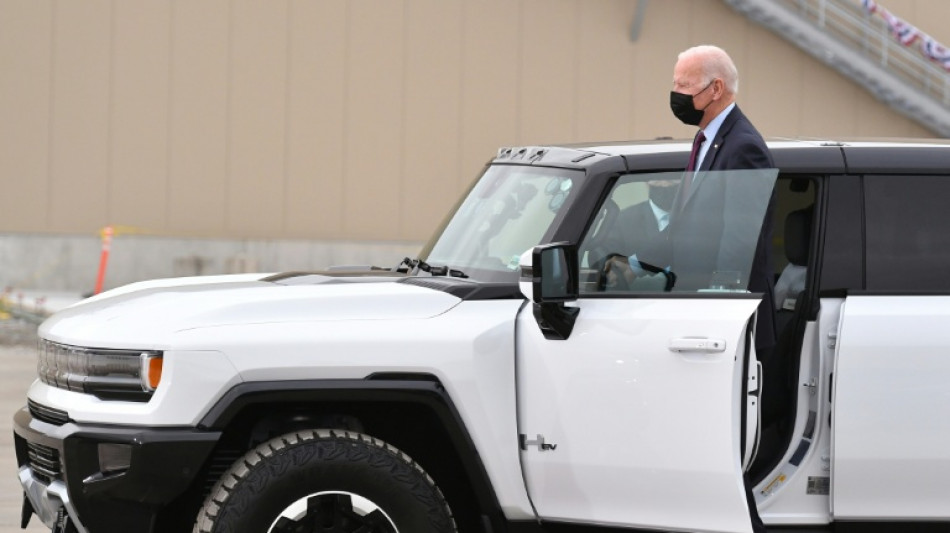
In January 2021, for example, GM set a target of 100 percent zero-emission vehicle sales by 2035.
While it technically maintains this target, the company this year backed the Trump administration's weakening of a fuel economy rule to a level that would require no further improvement.
"GM believes that the EV transition must account for market and consumer realities... Ultimately the market will determine how quickly the EV transition occurs," the company wrote in a comment supportive of the rule.
- First wave, then backlash -
Tanner, who has tracked this topic since 2015, said few companies supported climate policy action at first, but momentum grew after the 2015 Paris Agreement and landmark legislation in Europe and in the United States under former president Joe Biden.
A backlash to that first wave of high-ambition commitments began around 2023, with Trump bringing "a tailwind for some of the negative actors," he said.
Pushback came from the fossil fuel sector and companies reliant on it, such as utilities, but also the US Chamber of Commerce, Tanner said.
Just this week, the chamber praised the Trump administration's rule to remove curbs on greenhouse gas emissions from power plants.
In 2020 retail giant Walmart committed to cutting emissions by around a third by 2025 and two-thirds by 2030 from a 2015 baseline. But in a 2024 report it acknowledged it would miss the first target as well as its recycling goals.
Also in 2020, Google pledged to run on carbon-free energy by 2030, in what CEO Sundar Pichai heralded as a "moonshot." But by 2024 it had stopped claiming its operations were carbon neutral, and this year it acknowledged its emissions were still rising.
Beverage giants Coca-Cola and Pepsi have changed the baseline years for their emissions reduction targets and weakened their ambitions.
Even companies whose climate policies have held steady -- as with Apple under InfluenceMap's scoring -- have drastically reduced their public engagement.
Rachel Cleetus of the Union of Concerned Scientists said there was a clear limit to corporate climate action.
"I think it's pretty clear that voluntary commitments and announcements are always going to be insufficient and we actually do need mandatory public policies on the books," she told AFP.
"Without those policies... we just get this whiplash effect where companies are just swinging in the wind as politics change."
H.Dolezal--TPP