China has slashed air pollution, but the 'war' isn't over / Photo: Pedro PARDO - AFP
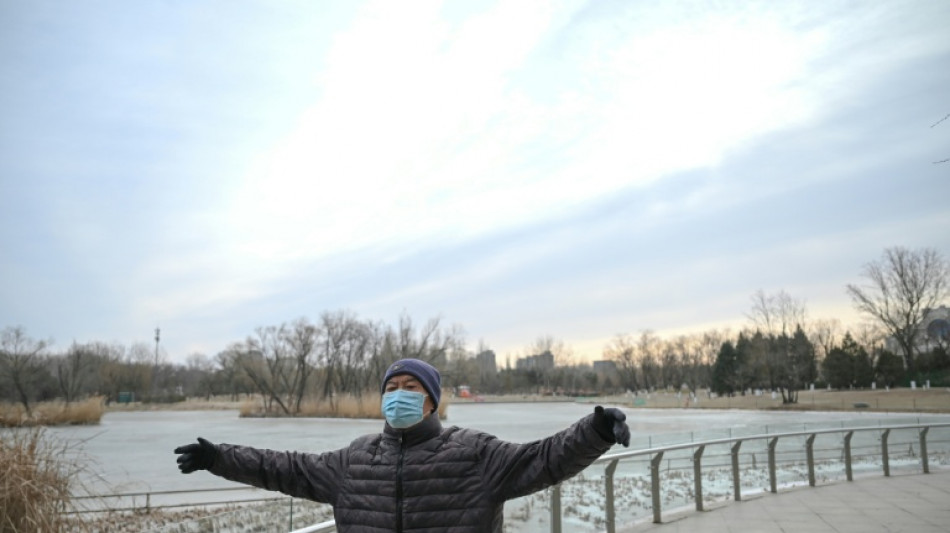
Fifteen years ago, Beijing's Liangma riverbanks would have been smog-choked and deserted in winter, but these days they are dotted with families and exercising pensioners most mornings.
The turnaround is the result of a years-long campaign that threw China's state power behind policies like moving factories and electrifying vehicles, to improve some of the world's worst air quality.
Pollution levels in many Chinese cities still top the World Health Organization's (WHO) limits, but they have fallen dramatically since the "airpocalypse" days of the past.
"It used to be really bad," said Zhao, 83, soaking up the sun by the river with friends.
"Back then when there was smog, I wouldn't come out," she told AFP, declining to give her full name.
These days though, the air is "very fresh".
Since 2013, levels of PM2.5 -- small particulate that can enter the lungs and bloodstream -- have fallen 69.8 percent, Beijing municipality said in January.
Particulate pollution fell 41 percent nationwide in the decade from 2014, and average life expectancy has increased 1.8 years, according to the University of Chicago's Air Quality Life Index (AQLI).
China's rapid development and heavy coal use saw air quality decline dramatically by the 2000s, especially when cold winter weather trapped pollutants close to the ground.
There were early attempts to tackle the issue, including installing desulphurisation technology at coal power plants, while factory shutdowns and traffic control improved the air quality for events like the 2008 Olympics.
But the impact was short-lived, and the problem worsened.
- Action plan -
Public awareness grew, heightened by factors like the US embassy in Beijing making monitoring data public.
By 2013, several international schools had installed giant inflatable domes around sport facilities to protect students.
That year, multiple episodes of prolonged haze shrouded Chinese cities, with one in October bringing northeastern Harbin to a standstill for days as PM2.5 levels hit 40 times the WHO's then-recommended standard.
The phrase "I'm holding your hand, but I can't see your face" took off online.
Later that year, an eight-year-old became the country's youngest lung cancer patient, with doctors directly blaming pollution.
As concerns mounted, China's ruling Communist Party released a ten-point action plan, declaring "a war against pollution".
It led to expanded monitoring, improved factory technology and the closure or relocation of coal plants and mines.
In big cities, vehicles were restricted and the groundwork was laid for widespread electrification.
For the first time, "quantitative air quality improvement goals for key regions within a clear time limit" were set, a 2016 study noted.
These targets were "the most important measure", said Bluetech Clean Air Alliance director Tonny Xie, whose non-profit worked with the government on the plan.
"At that time, there were a lot of debates about whether we can achieve it, because (they were) very ambitious," he told AFP.
The policy targeted several key regions, where PM2.5 levels fell rapidly between 2013 and 2017, and the approach was expanded nationwide afterwards.
"Everybody, I think, would agree that this is a miracle that was achieved in China," Xie said.
China's success is "entirely" responsible for a decline in global pollution since 2014, AQLI said last summer.
- 'Low-hanging fruits' gone -
Still, in much of China the air remains dangerous to breathe by WHO standards.
This winter, Chinese cities, including financial hub Shanghai, were regularly among the world's twenty most polluted on monitoring site IQAir.
Linda Li, a running coach who has lived in both Beijing and Shanghai, said air quality has improved but she still loses up to seven running days to pollution in a good month.
A top environment official last year said China aimed to "basically eliminate severe air pollution by 2025", but the government did not respond when AFP asked if that goal had been met.
Official 2025 data found nationwide average PM2.5 concentrations decreased 4.4 percent on-year.
Eighty-eight percent of days featured "good" air quality.
However, China's current definition of "good" is PM2.5 levels of under 35 micrograms per cubic metre, significantly higher than the WHO's recommended five micrograms.
China wants to tighten the standard to 25 by 2035.
The last five years have also seen pollution reduction slow.
The "low-hanging fruits" are gone, said Chengcheng Qiu from the Centre for Research on Energy and Clean Air (CREA).
Qiu's research suggests pollution is shifting west as heavy industry relocates to regions like Xinjiang, and that some cities in China have seen double-digit percentage increases in PM2.5 in the last five years.
"They can't just stop all industrial production. They need to find cleaner ways to produce the output," Qiu said.
There is hope for that, given China's status as a renewable energy powerhouse, with coal generation falling in 2025.
"Cleaner air ultimately rests on one clear direction," said Qiu.
"Move beyond fossil fuels and let clean energy power the next stage of development."
E.Soukup--TPP